
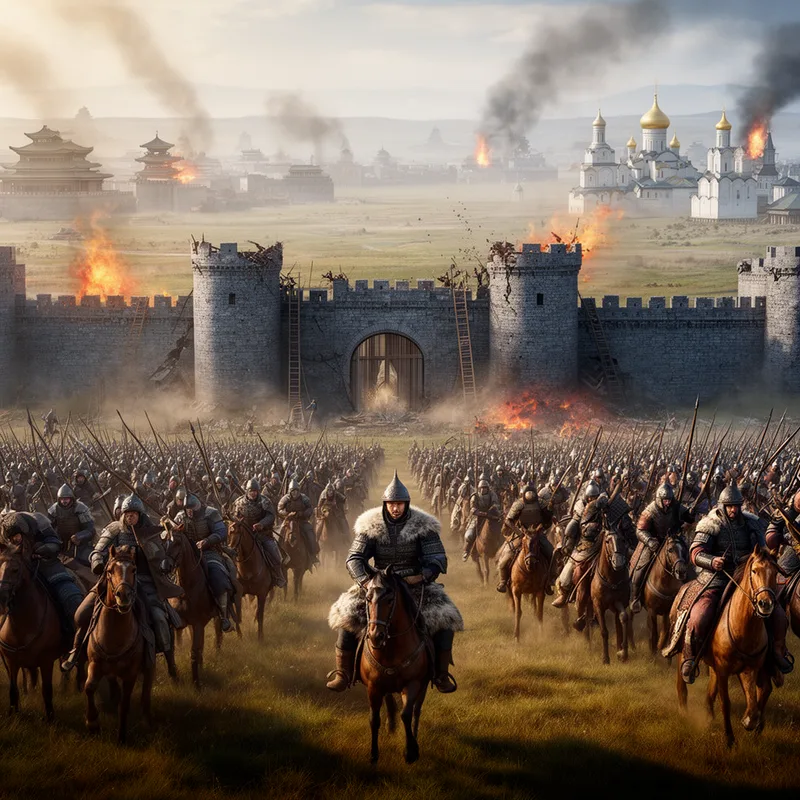
Mongol invasion


 1
7.9
1
7.9
- noun
- The Mongol invasion led to the establishment of a vast empire that stretched from China to Europe.
Examples
-
But because relatively few memorials to the Turkish and earlier Mongol invasions exist, as we noted above, the parallel is drawn through the design of the grave pole rather than from its placement.
Academic text (2000) -
The Mongol invasion was stopped by tradition and bureaucracy, not by a heroic Russian prince.
Blog text (12) -
Muhi, the site of the devastating defeat of Hungary during the Mongol invasion of 1242, received a major new memorial in 1992.
Academic text (2000) -
Moreover, the conversion of the Kingdom of Khazaria, which spread over the area between the Caspian and Black seas, into Judaism around 740 A.D., followed by the migration of Khazar people to the West due to the Mongol invasion from the East, might have been the source of Ashkenazi Jews of Eastern Europe.
Academic text (2007) -
During the Mongol invasion, entire cities in the Middle East were destroyed, altering the region forever.
-
Historians often discuss the Mongol invasion as a turning point in the history of Eurasia.
Synonyms
 62
6.3
62
6.3
An act of taking control of a place or people by military force
Surface Forms
Morphology
The phrase is directly compositional: 'Mongol' names the people/empire and 'invasion' denotes a military entry to seize territory, so the combined meaning (military campaigns by Mongol forces) is predictable from the parts. This construction is transparent and common across languages (e.g. Spanish 'invasión mongola', French 'invasion mongole'), so a B1 learner who knows both constituents will readily infer the MWE meaning.
Etymology
Mongol invasion brings to mind the fast horsemen of the Mongol armies sweeping into towns and countryside in the 1200s, a sudden invasion that conquered many lands. So, the phrase means 'a series of military campaigns by Mongol forces that took control of vast territories'.