
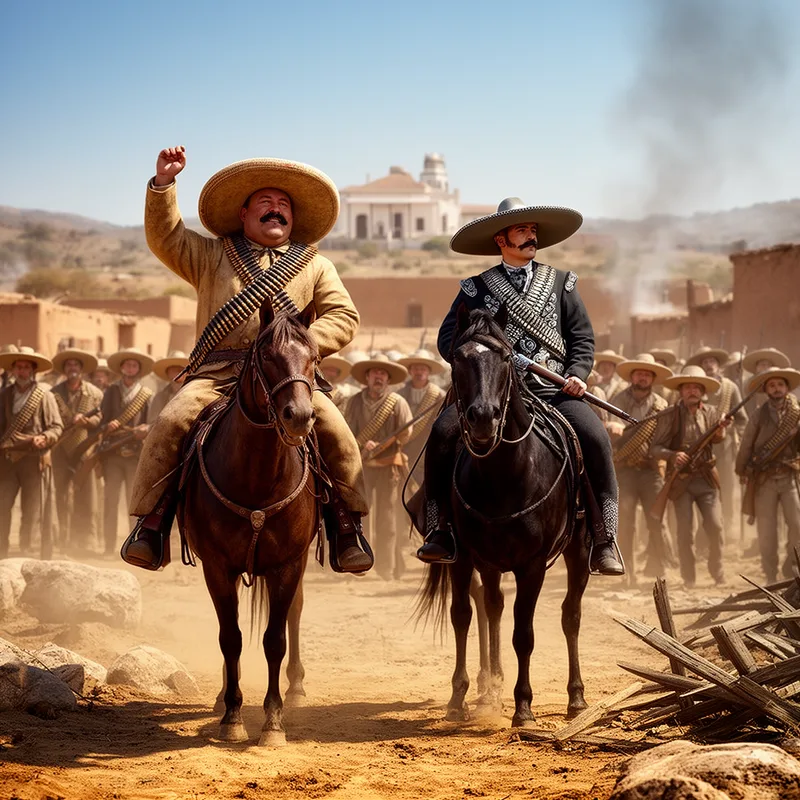
Mexican Revolution


 1
5.0
1
5.0
- proper noun
- The Mexican Revolution of 1910 marks the most significant point of transition in Mexico.
- Mexican Revolution, 1910
- Mexican Revolution (1910-1920
- Mexican Revolution's failure
Examples
-
In 1910, the Mexican Revolution transformed the political landscape of Mexico as citizens fought for social reforms.
-
During the Mexican Revolution, Namiquipans sided first with Pancho Villa in his armed defense of local interests.
Academic text (1996) -
"La Cucaracha" became popular during the Mexican Revolution.
Academic text (1996) -
The Mexican Revolution of 1910 was an effort to bring about social change and equality for all Mexicans.
Academic text (1994) -
Around the time of the Mexican Revolution in 1910, this style and its songs emerged from rural ranches in Mexico.
Academic text (2008) -
The Mexican Revolution of 1910 was a social revolution that significantly transformed class, ethnic, and gender relations.
Academic text (2002) -
Most historians agree that nationalism was a central economic and ideological component of the Mexican Revolution.
Academic text (1993) -
The resulting inequities led to the Mexican Revolution of 1910-1917, which brought legal structures permitting a more equitable property regime.
Academic text (2008) -
Jesusa's subaltern position underscores the Mexican Revolution's failure to live up to its implied promise to incorporate the disenfranchised into mainstream society.
Academic text (1998) -
Devra Weber notes that many Mexicans who immigrated to California during this period brought with them the knowledge and expectations of the Mexican Revolution, including the labor struggles of unions and strikes by urban workers and rural campesinos.
Academic text (2016)
Surface Forms
Morphology
The phrase is fully compositional: 'Mexican' (relating to Mexico) + 'revolution' (a major political/ social overthrow) yields the meaning 'a revolution in Mexico'. This construction is cross-linguistically transparent, so a B1 learner who knows both constituents will understand it denotes a major political upheaval in Mexico even if they lack historical details.
Etymology
The term Mexican Revolution comes from a dramatic time from 1910 to 1920 when people across Mexico, including farmers and leaders like Pancho Villa and Emiliano Zapata, rose up on horses and with guns to fight for land and rights. So, Mexican points to the country and Revolution means a sudden, large 'change', and today the phrase refers to that big social and political change in Mexico during those years.