
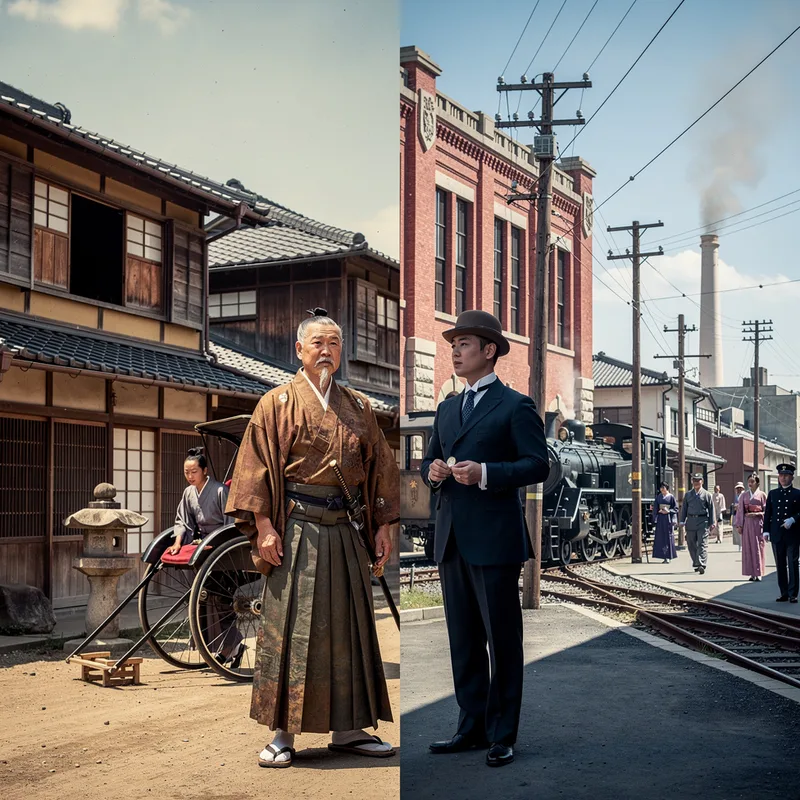
Meiji
 1
8.8

- proper noun
- /ˈmeɪdʒi/
- Most important of all, since the Meiji Restoration of 1868, economic development in Japan has been the highest public priority.
- the Meiji period
- Meiji Restoration
- Meiji Japan
Loading YouTube…
Watch on YouTubeIf you don't know about this, this is often called the Meiji Restoration.
- If you don't know about this, this is often called the Meiji Restoration.
Examples
-
The way to do this, the Meiji leaders believed, was to become a great power.
Academic text (1990) -
As during the Meiji Period, Japan's foreign policies and commercial interests became synonymous with national security interests.
Academic text (1996) -
Progressive Japanese of the Meiji era admired not only Western technology but also modern Western ideas.
Academic text (1994) -
The Meiji Restoration of 1868 had a profound effect on moral education and student development.
Academic text (2004) -
Ohsawa was born into a poor samurai family during the Meiji Restoration.
Blog text (26) -
Japan has not known a wealthy, powerful, confident, and internationalist China since its modernization during the Meiji era.
Academic text (1998) -
The transformation of the meaning of the emperor was the way the Meiji leaders fashioned their own imperial system after the Western monarchy model.
Academic text (1991) -
James A. Fujii discusses Japan since the Meiji period, underscoring how notions of the self are often problematically assigned by nationality.
Academic text (2013) -
Beginning with the overthrow of the feudal, samurai-led system of government, the Meiji Period saw the modernization of Japan through the complete transformation of its "political, economic, and social institutions." Id. at 153-54.
Academic text (2016) -
The Meiji period transformed Japan into a modern state through significant political and social reforms.
Surface Forms
Etymology
Meiji is the name for the period of Japanese history from 1868 to 1912 and it is named after the emperor, using the characters 明 'bright' and 治 'rule' to mean 'enlightened rule'. That's why the Meiji period is remembered for rapid modernization and big changes.