

Maryland yellowthroat
- noun
- /ˈmɛrɪlənd ˈjɛloʊθroʊt/
- Specialized
- The male Maryland yellowthroat is easily recognized by its black mask and bright yellow throat.
Examples
-
We spotted a Maryland yellowthroat singing near the edge of the marsh.
-
The Maryland yellowthroat is often found in wetlands.
-
During migration, Maryland yellowthroats can be seen in a variety of habitats across North America.
-
I spotted a Maryland yellowthroat in the bushes.
-
The male Maryland yellowthroat is easily recognized by its black mask and bright yellow throat.
-
During migration, Maryland yellowthroats can be seen in a variety of habitats across North America.
-
We spotted a Maryland yellowthroat singing near the edge of the marsh.
Synonyms

A small North American songbird with a bright yellow front and a black face mask

A small bird with a bright yellow throat found in wet places like marshes
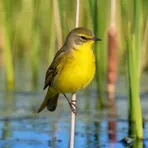
A small bird found in North America with an olive back and yellow chest and throat
Surface Forms
Morphology
This is a straightforward place-name + species compound: 'Maryland' locates and 'yellowthroat' names the bird, so the meaning ('a yellowthroat associated with Maryland') is directly compositional. Place + noun taxonomic naming is cross-linguistically common and therefore immediately understandable to a learner who knows both constituents.
Etymology
Maryland yellowthroat is named for a place and a clear picture: Maryland and the bird's bright yellow throat. Because the male also has a black face 'mask', the name gives a simple way to recognize this small North American songbird today.

