
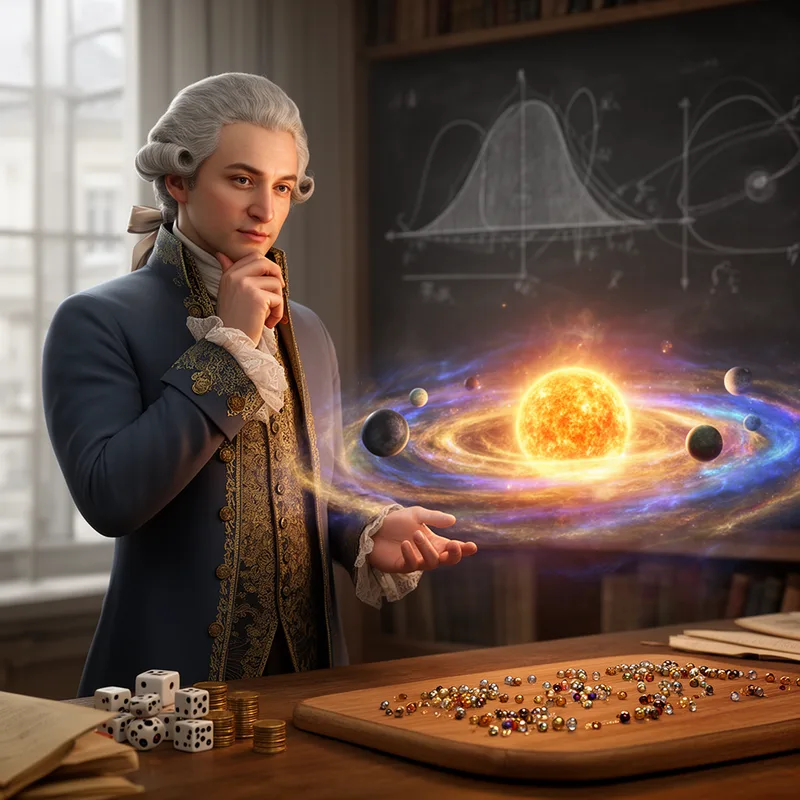
Marquis de Laplace
- proper noun
- /mɑrˈki dɪ ləˈplɑs/
- When studying the origins of the solar system, scientists often reference the Marquis de Laplace and his nebular hypothesis.
Examples
-
The contributions of Marquis de Laplace revolutionized our understanding of probability and celestial mechanics.
-
Many consider the Marquis de Laplace one of the founding fathers of modern astronomy and mathematics.
-
The Marquis de Laplace made significant contributions to mathematics.
-
Did you know that the Marquis de Laplace developed the theory of probability?
-
Many consider the Marquis de Laplace one of the founding fathers of modern astronomy and mathematics.
-
The contributions of Marquis de Laplace revolutionized our understanding of probability and celestial mechanics.
-
When studying the origins of the solar system, scientists often reference the Marquis de Laplace and his nebular hypothesis.
Synonyms

 1
9.9

A French mathematician and astronomer known for work on probability and the origin of the solar system
Surface Forms
Morphology
This is a compositional honorific formed from 'marquis' (a nobleman) + 'de' (of/from) + the proper name 'Laplace', so its meaning — a noble title referring to the person Laplace — is directly derivable from the constituents. The title + of + name pattern is cross-linguistically common, so a B1 learner who knows the parts would recognize it as a nobleman's name even if they lacked biographical knowledge.
Etymology
Marquis de Laplace uses Marquis, a noble title, and de, meaning 'from', so it names a nobleman called Laplace. He was Pierre-Simon Laplace, a French scientist who imagined the solar system forming from a giant cloud and who helped build the modern study of probability, so his name now reminds us of those ideas.