
Laplace
 1
9.9

- proper noun
- /ləˈplæs/
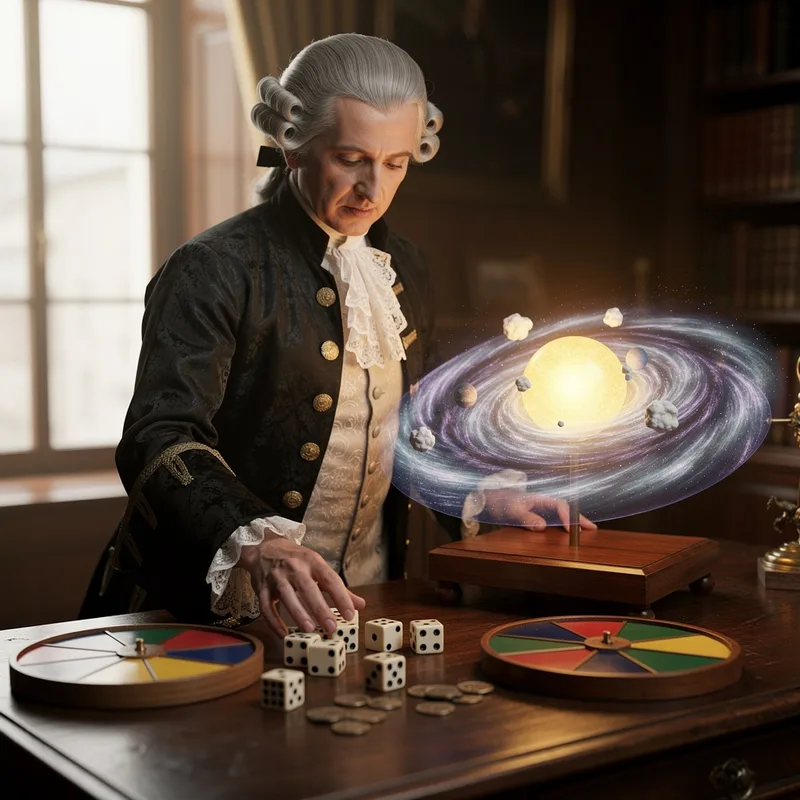
- The exchange between Pierre-Simon Laplace and Napoleon, though apocryphal, captures the essence of this belief.
- Pierre-Simon Laplace
- Simon Laplace
- Laplace Nebular Hypothesis
Examples
-
Pierre-Simon Laplace made significant contributions to the field of statistics.
-
I would like you to meet Professor Laplace.
-
As Laplace said, "I have no need of that hypothesis."
-
Progress on the subject has been made by jumps, sometimes huge, as was the one made by Laplace and Young 200 years ago.
Academic text (2006) -
Writing 70 years later, Maxwell described Laplace's contribution as "an example which has never been surpassed."
Academic text (2006) -
Laplace's ideas were further amplified by Adolphe Quetelet, who was a student of Joseph.
Academic text (2005) -
In the late eighteenth century, the French mathematician Pierre-Simon de Laplace invented perturbation theory; see "Going Ballistic," by Neil deGrasse Tyson.
Academic text (2003) -
In his work on the nebular hypothesis, Laplace proposed how the solar system formed.
-
The famous mathematician and astronomer Laplace had a profound influence on modern physics.
Synonyms
A French scientist famous for ideas about probability and the solar system forming from a cloud of gas
Surface Forms
Etymology
The name Laplace comes from the French parts la 'the' and place 'place', a word for a town square, and it was the family name of the French scientist Pierre-Simon Laplace. That's why his equations and ideas are named after him.