

Marmota monax
- noun
- /mɑrˈmoʊtə ˈmɒnæks/
- Specialized
- The Marmota monax is also commonly known as the groundhog or woodchuck.
Examples
-
During winter, the Marmota monax hibernates underground to survive the cold temperatures.
-
Scientists observed a Marmota monax emerging from its burrow at dawn.
-
The Marmota monax is known for its burrowing habits.
-
I saw a Marmota monax in my backyard yesterday.
-
The Marmota monax, commonly called the groundhog, is known for its annual weather prediction on Groundhog Day.
-
Wildlife experts study the Marmota monax to understand its behavior during the changing seasons.
-
During spring, the Marmota monax can often be seen foraging for food in the fields.
Synonyms

 19
3.5
19
3.5

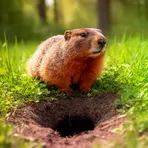
A brown North American animal that digs a hole and looks like a large squirrel
 10
5.9
10
5.9
A small reddish-brown North American animal also called a groundhog that lives in holes in the ground
Surface Forms
Morphology
Marmota + monax
This is a Latin taxonomic binomial: a B1 learner who knows 'Marmota' (a genus of marmots) can infer the phrase refers to a marmot-type animal, so there is some compositional clue. However the specific epithet 'monax' is not informative to learners and does not directly yield the common name 'groundhog', so the full meaning is not fully predictable from the parts.
Etymology
Marmota monax may come from two parts: Marmota (the marmot family) and monax, a word from Native American languages meaning 'digger' or 'ground animal'. That image — a brown marmot that digs burrows and sleeps through winter — explains why the name points to the groundhog we know today.