
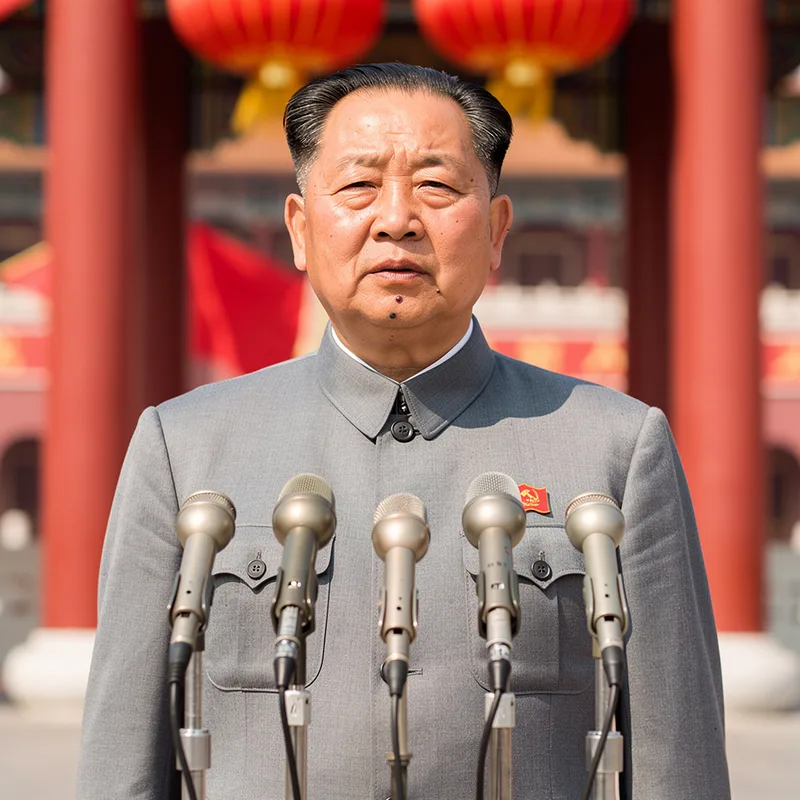
Mao
 98
5.3
98
5.3

- proper noun
- /maʊ/
- Chairman Mao was the founding father of the People's Republic of China and ruled from 1949 until his death in 1976.
- Mao Zedong
- Chairman Mao
- Mao Zedong Thought
Loading YouTube…
Watch on YouTubeSo how did China evolve after Mao's death to today?
- So how did China evolve after Mao's death to today?
- Stalin's Haltomore, Hitler's Holocaust, Mao's great Chinese famine.
- And then things came out which were very unflattering to the Mao years.
- Shanghai's fall highlights the gulf between Chang's urban supporters and Mao's rural ones.
- Hua had vowed to uphold whatever policy decisions Chairman Mao made and unswervingly follow whatever instructions Chairman Mao had given.
- Hitler did it as if it was his own idea, the little Red book from Chairman Mao.
- OK, so the triangle of evil is Mao, Stalin, Hitler.
- Yeah, Mao killed more people in Stalin because Mao had more people to kill.
- This is a problem that Mao really does not have to deal with.
- So if you hear anybody saying something challenging Mao or party that's crime.
- You're part of the Ummah, just like Mao TSE Tung, just like communism.
Examples
-
A large portrait of Mao is at the entrance to the street.
Fiction book (1992) -
From now on, the party will follow Mao's vision, not Moscow's.
-
Without a modern navy and air force, Mao was in no position to challenge the United States.
Academic text (1999) -
Chairman Mao asks me to convey his respect.
-
Finally, Mao left home to continue his schooling.
-
This is a ceremonial robe given to me by Chairman Mao.
-
As stated earlier, after the death of Mao Zedong, the Chinese leadership embarked on a path of liberalization.
Academic text (1999) -
We will always uphold the superiority of Marxist-Leninist-Mao Zedong Thought over any other.
Fiction book (1994) -
Although viewers may draw parallels between XI and Mao, Xi Jinping is no Maoist.
-
Many historians study Mao to understand the impact of his policies on modern China.
Synonyms
 1
3.8
1
3.8
A Chinese communist leader who helped found the People's Republic of China
A Chinese communist leader who founded and led China from 1949 to 1976
Compounds


 1
8.0
1
8.0
A short, light jacket with a high stand-up collar that leaders wore in China during Mao Zedong's time
Surface Forms
Etymology
Mao is a common Chinese family name written 毛, which means 'hair' or 'fur'. Because the leader Mao Zedong was so famous, people often use just Mao to mean the Chinese leader who founded the People's Republic of China.