

Magellanic Cloud
 1
9.4
1
9.4

- noun
- /məˈdʒɛlənɪk klaʊd/
- Specialized
- Notre Dame astrophysicists used the VLT to observe gas in the Small Magellanic Cloud to constrain the cosmic abundance of lithium.
- the Large Magellanic Cloud
- the Small Magellanic Cloud
Examples
-
At that time, both the Magellanic Clouds and Leo I were companions to Andromeda.
Academic text (1994) -
It was in studying variables in the Magellanic Clouds that Leavitt made her greatest discovery.
Academic text (1992) -
SN1987A can be found in the Large Magellanic Cloud.
Academic text (2005) -
In my humble opinion, the Magellanic Clouds are the most impressive sights to the naked eye and are alone worth the trip to Australia.
Academic text (2002) -
About six billion years ago, the Magellanic Clouds were "captured" by the Milky Way; they may eventually collide with it.
Academic text (1994) -
Located 160,000 light-years away in the Large Magellanic Cloud, 30 Doradus resembles star-forming regions in our own galaxy, but on a much larger scale.
Academic text (1994) -
When a fifteen-solar-mass supergiant star detonated in the nearby Large Magellanic Cloud in 1987, astronomers were delighted to have the chance to study a supernova "up close and personal."
Academic text (1994) -
The Large Magellanic Cloud is one of the closest galaxies to the Milky Way, located 163,000 light-years away.
-
Astronomers study the Small Magellanic Cloud to learn more about galaxy formation and evolution.
-
The Magellanic Clouds are visible in the night sky from the Southern Hemisphere, offering spectacular views.
Synonyms
 525
4.1
525
4.1
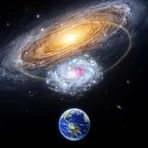
A large system of stars, gas, and dust held together by gravity

 1
8.8
1
8.8
A nearby irregular galaxy visible from the southern sky that orbits the Milky Way

A small irregular galaxy near the Milky Way that you can see from the Southern Hemisphere

A large group of stars and dust outside our galaxy
Surface Forms
Morphology
Magellanic + Cloud
The compound transparently signals a ‘cloud’ associated with Magellan—so a B1 learner who knows both constituents would likely infer an astronomical object or sky feature tied to Magellan. However, the precise, technical sense (that these are specific irregular dwarf galaxies) is specialized knowledge not directly derivable from the parts, so the meaning is only partially predictable.
Etymology
Magellanic Cloud comes from the explorer Ferdinand Magellan, who in the 1500s wrote about a faint, cloud-like patch he saw in the southern sky. Sailors called such bright patches 'clouds', and because Magellan noted them the name now refers to the two 'small galaxies' visible from the Southern Hemisphere.