
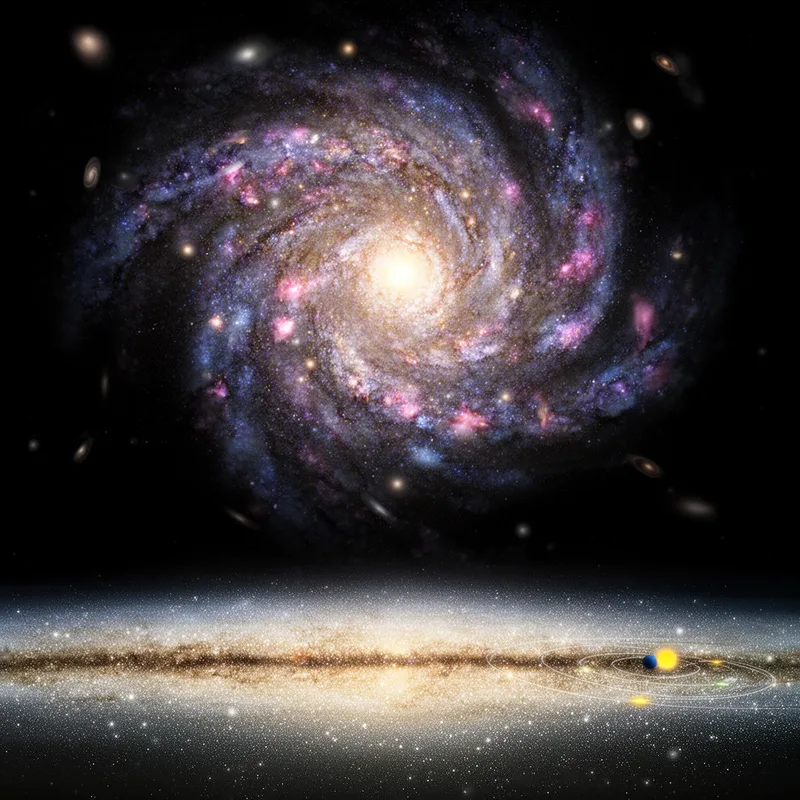
extragalactic nebula
- noun
- /ˌɛkstrəɡəˈlæktɪk ˈnɛbjʊlə/
- Archaic
- Historically, the term extragalactic nebula referred to what we now call galaxies, such as the Whirlpool Galaxy.
Examples
-
The Andromeda Galaxy is classified as an extragalactic nebula due to its vast distance from the Milky Way.
-
It is the only extragalactic nebula that can be seen with the unaided eye.
Academic text (2000) -
Astronomers discovered a new extragalactic nebula that contains billions of stars and is located millions of light-years away.
Synonyms

 525
4.1
525
4.1

A large system of stars, gas, and dust held together by gravity

 1
8.1
1
8.1
A large group of stars in a flat spiral shape with arms of young stars around an older centre
Surface Forms
Morphology
The phrase is directly compositional: 'extragalactic' (beyond the Milky Way) modifies 'nebula' (an interstellar cloud), so a learner who knows both words can infer ‘a nebula located outside our galaxy’. Although the historical usage referring to whole galaxies is specialized, the modifier+noun meaning follows standard semantics and is cross-linguistically transparent.
Etymology
The old name extragalactic nebula comes from a simple picture: a nebula was a fuzzy cloud of stars and extragalactic meant outside our galaxy. So fuzzy patches seen beyond the Milky Way were called extragalactic nebula, which is why the phrase once meant what we now call a 'galaxy'.