

Lotus corniculatus
- noun
- Specialized
- Farmers appreciate Lotus corniculatus for its palatability and as a nutritious forage for livestock.
Examples
-
The fields were covered in bright yellow blooms of Lotus corniculatus during the late spring.
-
Lotus corniculatus is often planted to improve soil fertility due to its nitrogen-fixing properties.
-
The Lotus corniculatus is often used in animal feed.
-
Farmers appreciate Lotus corniculatus for its drought resistance.
-
Lotus corniculatus provides excellent cover for the soil and is beneficial for local wildlife.
-
Many farmers grow Lotus corniculatus to enhance the quality of their pastures.
-
In spring, the bright yellow flowers of Lotus corniculatus attract various pollinators.
Synonyms

A small plant with yellow flowers and seed pods like a bird's foot often grown for animals to eat
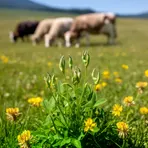
A small European plant with claw-shaped pods that farm animals eat

A small European wild plant with bright yellow and orange flowers

A European plant grown for animal food with claw-shaped seed pods

A low-growing plant with small yellow flowers and curved black seed pods
Surface Forms
Morphology
Lotus + corniculatus
This is a Latin binomial (genus + species) used as a technical botanical name; the species epithet 'corniculatus' is not an English word and is not transparent to a B1 learner. Knowing 'Lotus' alone does not allow a learner to infer the specific plant or its properties, so the meaning is non-compositional and unpredictable for typical learners.
Etymology
Lotus corniculatus comes from Latin names for the plant and its shape. The second word corniculatus means 'little horns' and paints the picture of the plant's claw-shaped seed pods, so the name helps you remember it is the yellow wild pea with small horn-like pods.

