

Listeria monocytogenes


 1
7.6
1
7.6
- noun
- /lɪˈstɪəriə ˌmɒnəˈsaɪtəʊdʒəniːz/
- Specialized
- In the lab, plant pathologist William S. Conway has already shown that the Listeria monocytogenes bacterium can grow on fresh-cut apple slices.
- Listeria monocytogenes, a bacterium
- Listeria monocytogenes can cause
Examples
-
Listeria monocytogenes is the causative agent of listeriosis in both humans and animals (Food and Drug Administration FDA, 2001a).
Academic text (2005) -
These include E. coli O157:H7, Salmonella, and Listeria monocytogenes.
Academic text (1999) -
Listeria monocytogenes was commonly isolated from all sorts of foods.
Academic text (2002) -
Sommers has done extensive work with ionizing radiation to eliminate Listeria monocytogenes from RTE meats.
Academic text (2005) -
RTE foods, including prepared deli salads, may contain Listeria monocytogenes by way of contaminated ingredients, post-process contamination, or both.
Academic text (2005) -
Illness caused by the bacterium Listeria monocytogenes may be either mild or severe.
-
Ingestion of the organism Listeria monocytogenes can cause serious illness and is potentially fatal in young children, the elderly, or people with a weakened immune system.
-
Listeria monocytogenes can cause serious and sometimes fatal infections in young children, frail or elderly people, and others with weakened immune systems.
Synonyms
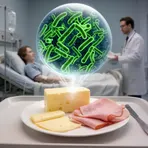
A bacterium that causes serious infections after eating contaminated food
Surface Forms
Morphology
Listeria + monocytogenes
This is a scientific binomial combining a known bacterial genus (Listeria) with a technical species epithet; a learner who knows 'Listeria' could infer it names a particular species of that bacterium. However, 'monocytogenes' is a specialized, Greek‑derived term that B1 learners will not transparently interpret, and recognising the clinical implications (causing listeriosis) requires domain knowledge beyond simple constituent meanings.
Etymology
Listeria monocytogenes is named after the surgeon Joseph Lister, who worked to make surgery cleaner. The second part uses Greek pieces, mono meaning 'one' and -gen meaning 'to produce', so the name tells scientists it is a particular bacterium and today it is used for the bacteria that can cause serious illness.