
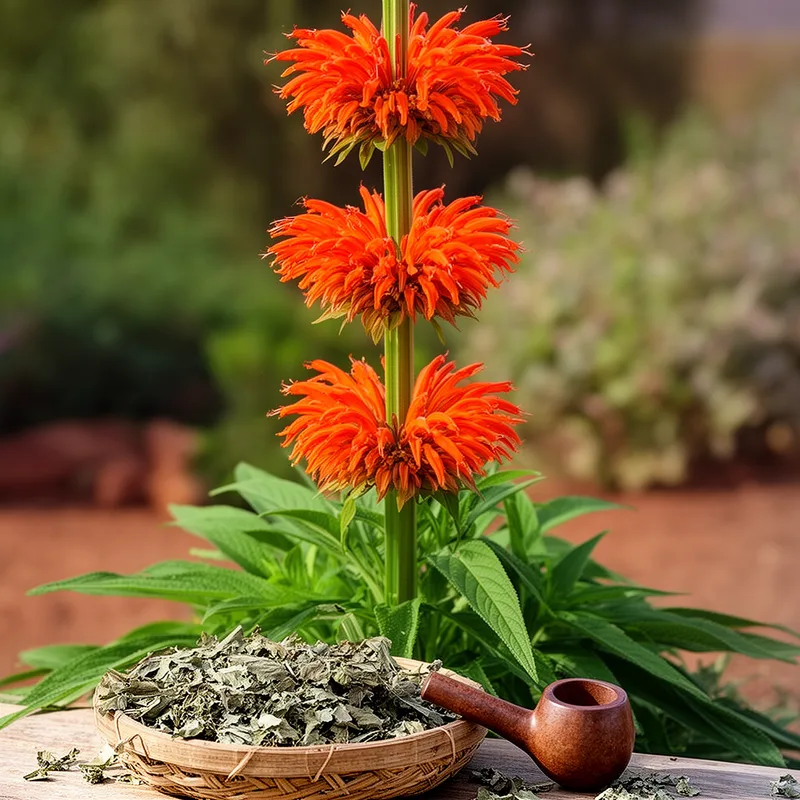
Leonotis leonurus
- noun
- NSFW
- Some people smoke the dried leaves of Leonotis leonurus as an herbal alternative to tobacco.
Examples
-
The bright orange flowers of Leonotis leonurus attract many pollinators to the garden.
-
Traditional healers in South Africa often use Leonotis leonurus for its medicinal properties.
-
The Leonotis leonurus is known for its striking orange flowers.
-
Have you ever seen a Leonotis leonurus plant in bloom?
-
Some people smoke the dried leaves of Leonotis leonurus as an herbal alternative to tobacco.
-
Traditional healers in South Africa often use Leonotis leonurus for its medicinal properties.
-
The bright orange flowers of Leonotis leonurus attract many pollinators to the garden.
Synonyms

A South African plant with bright orange flowers whose leaves are sometimes smoked like tobacco

A South African herb smoked like tobacco for mild effects

A South African plant with orange flowers that people smoke to feel calm
Surface Forms
Morphology
Because the term is a Latin binomial composed of two genus names, a learner who knows the constituent definitions can infer that this is a plant name and may guess herbal/medicinal or floral properties from the genera. However, the specific species-level details (South African distribution, orange tubular flowers, or use as a tobacco substitute) are not fully predictable from the parts alone, so the meaning is only partially transparent.
Etymology
Leonotis leonurus gets its name from Greek and Latin words. The parts leonotis and leonurus both refer to 'lion' or 'lion's tail'. The bright orange, tube-shaped flowers look like a lion's ear or tail, so the name helps you remember this South African plant whose leaves are sometimes smoked as a 'tobacco substitute'.

