

Larrea tridentata
- noun
- Specialized
- The Larrea tridentata, also known as the creosote bush, is a vital part of the desert ecosystem.
Examples
-
The distinctive smell of Larrea tridentata fills the air after a desert rain.
-
Many animals in the desert rely on the Larrea tridentata for shade and food.
-
Botanists study Larrea tridentata to understand how plants survive in arid climates.
-
The Larrea tridentata is a common sight in the Mojave Desert.
-
Many people appreciate the Larrea tridentata for its resilience in harsh environments.
-
In the hot summers, the Larrea tridentata provides necessary shelter for various desert species.
-
The leaves of the Larrea tridentata produce a characteristic aroma that is distinctive in desert landscapes.
Synonyms
 1
9.8
1
9.8

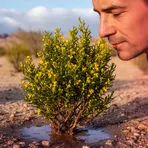
A desert shrub with sticky leaves that have a strong smell and small yellow flowers

A desert bush with sticky, scented leaves and small yellow flowers
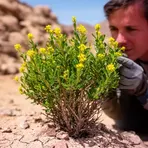
A desert shrub with sticky, scented leaves and small yellow flowers
Surface Forms
Morphology
Larrea + tridentata
This is a scientific Latin binomial (genus + species). A learner who knows 'Larrea' can infer the phrase denotes a type/species of shrub, but the species epithet 'tridentata' is a Latin form not transparent to B1 learners and does not transparently yield the common name or full meaning without botanical knowledge. Because part of the meaning (that it is a shrub) is inferable but the specific referent ('creosote bush') is not predictable from the constituents, the expression is only partially transparent.
Etymology
Larrea tridentata comes from two parts: Larrea, a Spanish family name used to honour a person, and tridentata, Latin for 'three-toothed', which describes the shape of its leaves. So the scientific name helps you picture this desert shrub, the 'creosote bush', with a strong smell and small yellow flowers.