
Laplacian


 1
9.7
- noun
- /ləˈplæs.i.ən/
- Specialized
- An in-focus image of the cell, when taken by a perfect microscope, would have no variations in intensity, and therefore the cell is the Laplacian of the phase map given in (a).
- Laplacian of the Gaussian
- Laplacian of the phase
Examples
-
The intensity distribution of a very slightly defocused image of a pure phase object is described by the Laplacian of the phase.
Academic text (2001) -
For fast electrons passing through sufficiently thin crystals, the defocus information yields the Laplacian of the projected potential of the crystal.
Academic text (2001) -
If you if you add a constant to Z, does the Laplacian of Z change?
-
The Laplacian of the Gaussian approach
Academic text (1995) -
The Laplacian of the Gaussian distribution yields.
Academic text (1995) -
So the Laplacian of PSI can be written actually as F time the Laplacian of Phi.
-
The Laplacian of the Gaussian is perhaps the best-known operator that can be considered for the extraction of image features (3).
Academic text (1995) -
For a sufficiently short distance and with negligible absorption, the intensity distribution at the detector will be described by the Laplacian of the phase.
Academic text (2001) -
PHOTOS (BLACK & WHITE): Figure 2a and b. a. Image feature extraction using the Laplacian of the Gaussian operator. b. Image feature extraction using the Wavelet Transform.
Academic text (1995) -
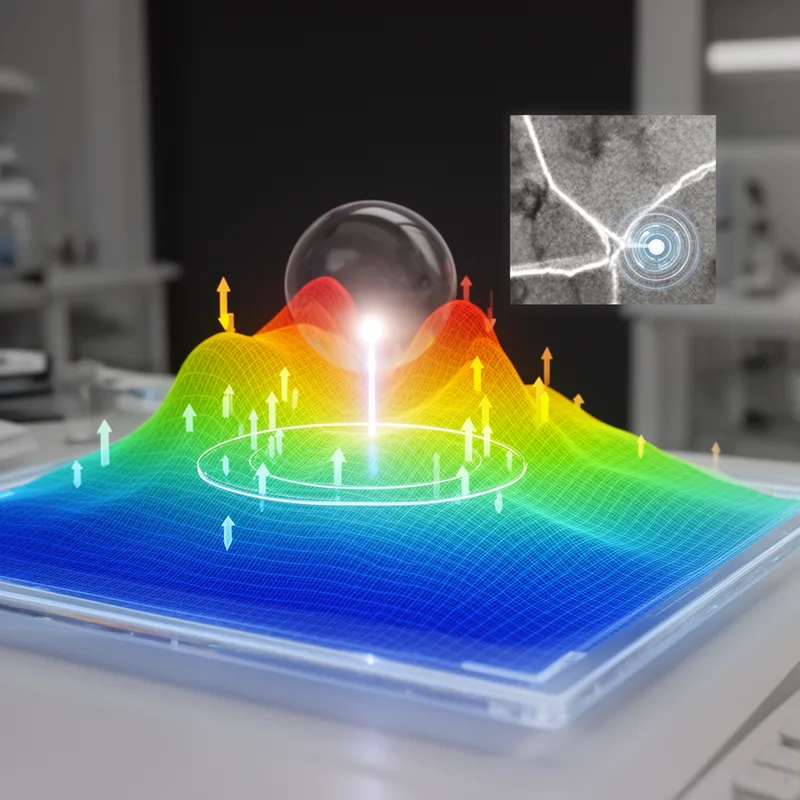
In physics, the Laplacian operator is crucial for modeling how temperature changes across a surface.
Surface Forms
Morphology
Etymology
Laplacian is named for the French scientist Laplace with the ending -ian meaning 'of' or 'related to'. Because Laplace studied how quantities spread or change, his name now labels the mathematical tool that measures how a value changes around a point.