
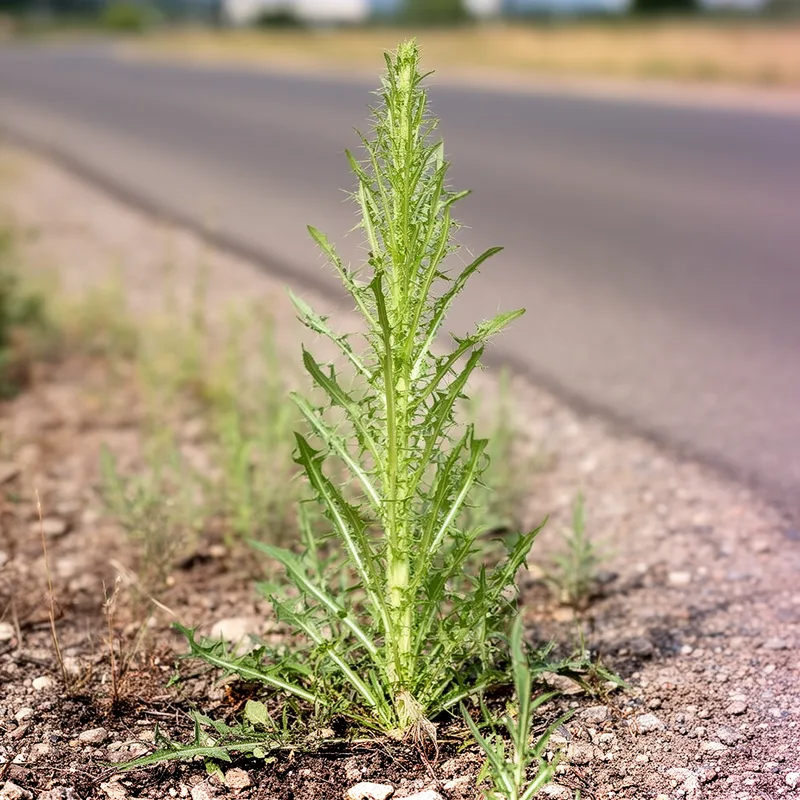
Lactuca serriola
- noun
- Specialized
- Some gardeners struggle to control Lactuca serriola because it spreads quickly as a weed.
Examples
-
Researchers study Lactuca serriola for its potential resistance to certain plant diseases.
-
Lactuca serriola, also known as prickly lettuce, often grows in abandoned lots and fields.
-
Lactuca serriola is often found growing along roadsides and in disturbed soils.
-
Lactuca serriola is commonly found in disturbed areas.
-
Many gardeners consider Lactuca serriola a nuisance plant.
-
Gardeners often find Lactuca serriola difficult to remove due to its ability to thrive in poor soil conditions.
-
In North America, Lactuca serriola is frequently regarded as an invasive weed that competes with native plants.
Synonyms

A wild plant from Europe with prickly stems that often grows in gardens as a weed
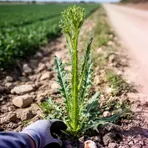
A wild lettuce with prickly stems that often grows as a weed

A prickly wild plant with yellow flowers that grows like a weed
Surface Forms
Morphology
Lactuca + serriola
The genus name 'Lactuca' directly signals a lettuce/plant, so part of the compound points clearly to a plant species. However 'serriola' is not an English lexical item (and appears as a Latin epithet), and taxonomic binomials require botanical or Latin knowledge to recover the precise common meaning, so a B1 learner would only partially infer that this is a type of lettuce without additional domain knowledge.
Etymology
Lactuca serriola comes from Latin words that describe the plant. Lactuca comes from the word for 'milk' because the plant makes a white, milky sap, and serriola means 'small saw' because its leaves have saw-like edges, so the name describes a milk-sap plant with saw-edged leaves.

