
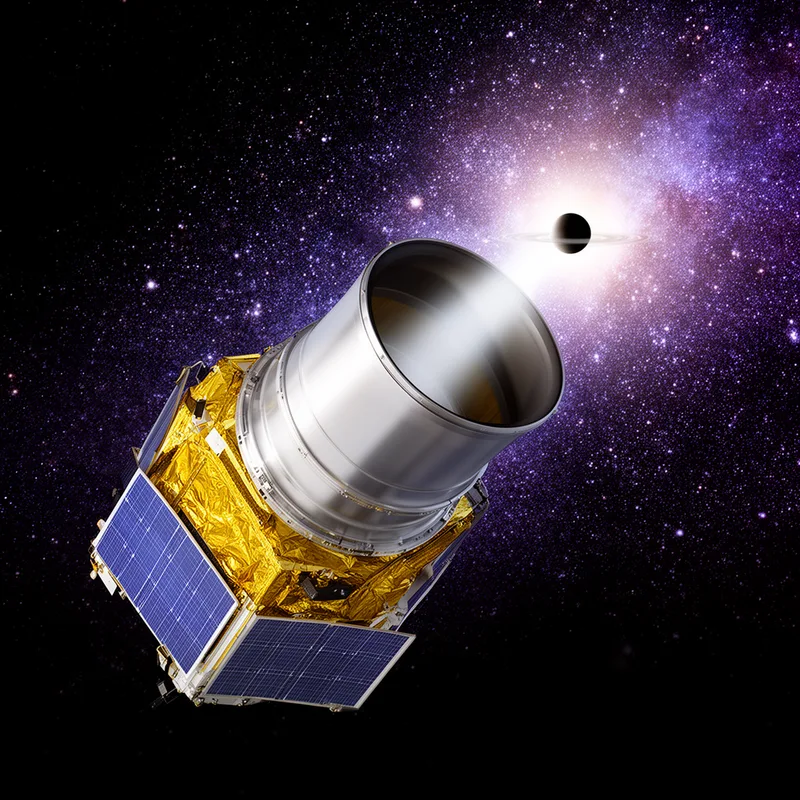
Kepler
 11
6.6
11
6.6

- proper noun
- /ˈkɛplər/
- Launched in 2009, Kepler was designed to find planets by observing transits in starlight.
- Kepler mission
Loading YouTube…
Watch on YouTubeAnd what Planet Hunters does is an interface that shows data from NASA's Kepler mission to the public.
- And what Planet Hunters does is an interface that shows data from NASA's Kepler mission to the public.
- So for example, NASA's Kepler mission, which looks at visible light coming from other stars in any and the main aim is to detect planets orbiting those stars.
- I hadn't foggiest, but it's fascinating to see how how much there was in that the little picture set of pictures of Kepler.
Examples
-
As one co-investigator on NASA's Kepler mission, he will help in the search for extrasolar terrestrial planets.
Academic text (2003) -
So far, Kepler has discovered nearly 400 objects that may prove to be Earth-like planets.
Academic text (2011) -
Even if a planet does not pass directly in front of its star, Kepler might be able to see it.
Academic text (1996) -
Now let's think about this because this is the most exciting aspect of the Kepler mission and why it's so powerful.
-
Today we know of hundreds of planets or even more from the Kepler satellite and so forth.
-
We know from the Kepler Space Telescope that planets around stars are the rule, not the exception.
-
The deployment of advanced space telescopes such as NASA's Kepler Mission has led to the discovery of hundreds of exoplanets.
Blog text (13) -
The messages were beamed to Earth by NASA's Kepler spacecraft, which circles the sun, spying on planets orbiting distant stars.
Blog text (5) -
Kepler has found Earth-sized exoplanets (illustration of Kepler-20e, above) and planets with Earth-like orbits.
Blog text (5) -
NASA's Kepler mission has transformed our understanding of planets beyond our solar system.
Surface Forms
Etymology
Kepler was the name given to a NASA space telescope in honour of Johannes Kepler, because he studied planets, so the mission looked for planets around other stars by watching tiny dips in starlight. That's why the word Kepler now often means the space telescope or its data.