
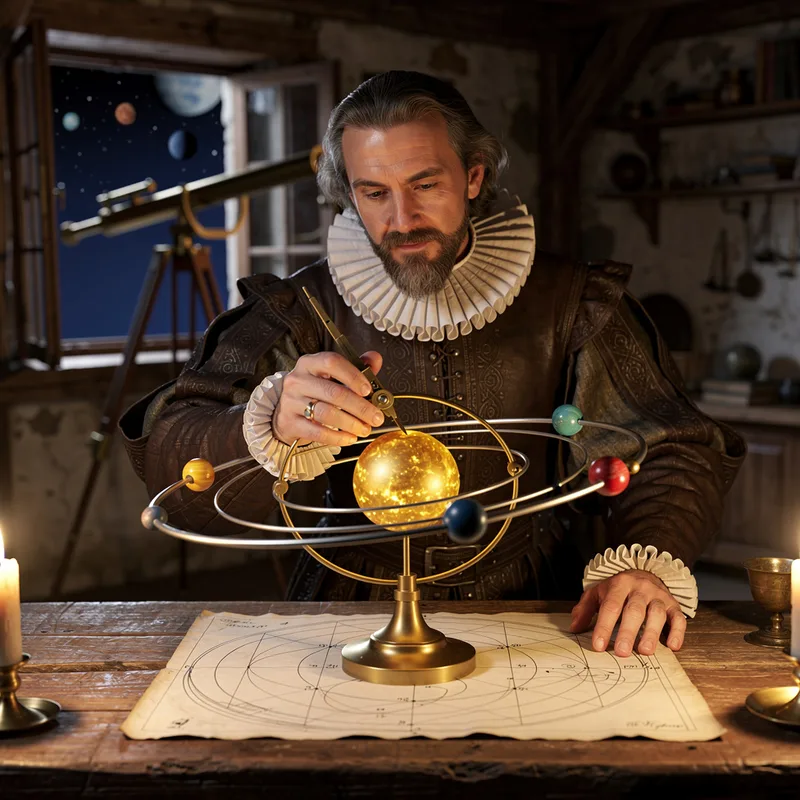
Kepler
 6
6.6
6
6.6

- proper noun
- /ˈkɛplər/
- But the piece of knowledge that he had was Kepler's laws of motion, planetary motion.
- Johannes Kepler
- Kepler's laws
- Kepler's third
Loading YouTube…
Watch on YouTubeHundreds of years ago, there was an astronomer whose name was Kepler, and he looked at the data points that he got by watching planets move.
- Hundreds of years ago, there was an astronomer whose name was Kepler, and he looked at the data points that he got by watching planets move.
Examples
-
I have seen the copies that belonged to Galileo, Giordano Bruno, Kepler, his teacher Michael Maestlin, and many others.
Academic text (1999) -
In other words, it's the same thing that Kepler defined in his vicarious hypothesis, the same principle.
Blog text (1) -
There never had been until Kepler, multiple planets in transit around one star.
-
Why did it take until the 17th century for the great discoveries of Kepler and Galileo to come about?
Academic text (2003) -
The disc around the star, young or old, rotates approximately according to Kepler's laws.
Academic text (1995) -
The knowledge humans have today of our solar system would astound Galileo or Kepler.
Academic text (1990) -
From these observations and Kepler's third law of planetary motion, students determine mighty Jupiter's mass.
Academic text (1996) -
Johannes Kepler formulated the laws of planetary motion in the early 17th century.
-
One of Kepler's significant contributions was demonstrating that planets move in elliptical orbits.
-
The studies of Kepler greatly improved our understanding of how celestial bodies interact in space.
Synonyms

A German astronomer who described how planets move around the sun
Surface Forms
Etymology
Kepler is the family name of Johannes Kepler, a German astronomer who lived 1571–1630 and discovered simple rules about how planets move. So Kepler usually means that scientist, and you see his name in phrases like Kepler's laws that explain planetary motion.