
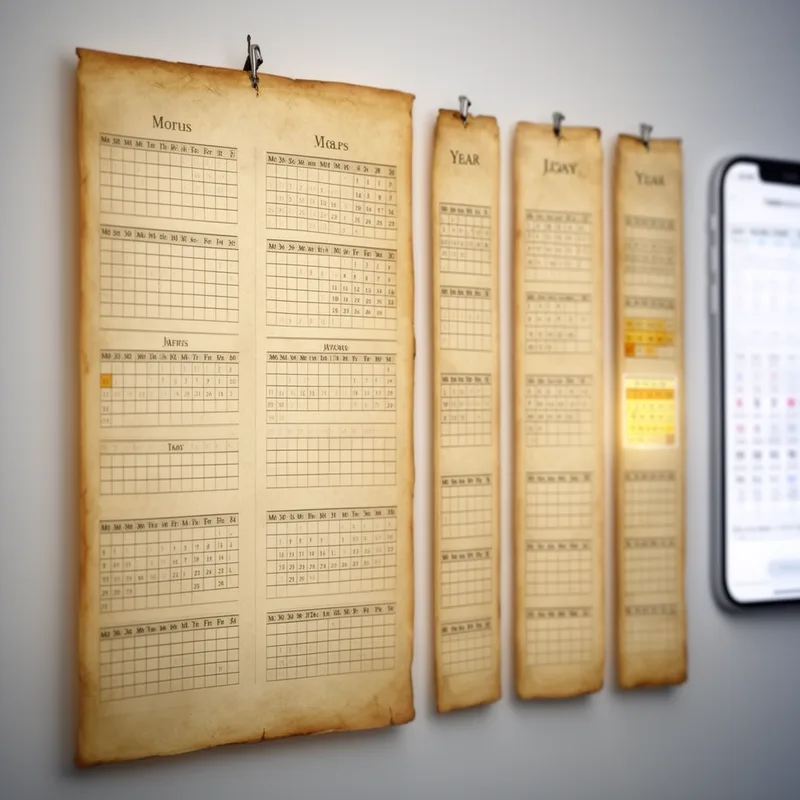
Julian calendar
 1
6.7
1
6.7

- noun
- /ˈdʒuːliən ˈkælɪndər/
- For dates before October 15, 1582, when the Gregorian calendar was adopted (a Friday, it turns out), one has to work with the Julian calendar.
Loading YouTube…
Watch on YouTubeBut the the evidence that the guy used was that the Julian calendar added days inaccurately.
- But the the evidence that the guy used was that the Julian calendar added days inaccurately.
Examples
-
Many Orthodox Christians celebrate Christmas on January 7 because they follow the Julian calendar.
-
In 1582, the Gregorian calendar we still use today was introduced by Pope Gregory XIII to replace the outdated Julian calendar, which had been implemented in 45 BC.
Blog text (11) -
The Julian calendar, with its leap day every four years, helped correct this problem to some extent, but not completely.
Blog text (10) -
The Jews, of course, used the Jewish calendar; the Romans used the Julian calendar.
Blog text (9) -
Since Jahangir was born on Aug. 21, 1569, on the Julian calendar, Leo was indeed the appropriate Sun sign for him.
Academic text (1995) -
The reason for his reform of the calendar was that the Julian calendar (in use since Roman times) had years that were too long; it shows the year as being 365 days, 6 hours in length—11 minutes more than in reality.
Blog text (26) -
The Julian calendar was widely used in Europe until the introduction of the Gregorian calendar in 1582.
-
Scholars study historical events using the Julian calendar to accurately convert dates from ancient Rome.
Synonyms

A 12-month calendar made by Julius Caesar in 46 BC with a leap day every four years
Surface Forms
Morphology
The phrase is a straightforward name + noun composition: 'Julian' (relating to Julius Caesar) + 'calendar' (a system for organizing years), so a learner who knows both words can infer it refers to the calendar introduced by Julius Caesar. This pattern is cross-linguistically common (e.g., calendario juliano, calendrier julien), making the meaning transparent to B1 learners.
Etymology
The Julian calendar is 'named after' the Roman leader Julius Caesar, who in 46 BC made a new calendar with 12 months, 365 days and a leap day every four years to fix the old Roman year. So the name points to Caesar's system and explains why people call the older European calendar the Julian calendar today.