

Juglans cinerea
- noun
- /ˈdʒʌɡləns sɪˈnɪəriə/
- Specialized
- The wood of Juglans cinerea is prized for its light color and easy workability.
Examples
-
Many wildlife species rely on the nuts produced by Juglans cinerea for food.
-
Fungal diseases have greatly reduced the population of Juglans cinerea in its native range.
-
The Juglans cinerea tree grows well in moist, well-drained soil.
-
Did you know that Juglans cinerea produces edible nuts?
-
The wood of Juglans cinerea is prized for its light color and easy workability.
-
Many wildlife species rely on the nuts produced by Juglans cinerea for food.
-
The Juglans cinerea tree grows well in moist, well-drained soil.
Synonyms

 5
1.0
5
1.0

A large tree that makes hard nuts and has long leaves made of many small parts
 2
2.7
2
2.7
A tree that makes nuts you can eat and strong wood for furniture
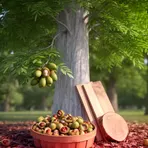 1
6.0
1
6.0
A North American tree that produces edible nuts and useful wood
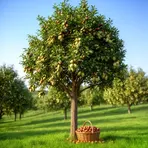 1
2.1
1
2.1
A tree that grows nuts you can eat
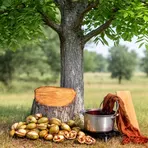
A North American tree with light brown wood, edible nuts, and shells used for dye

A North American tree that makes edible nuts and light brown wood used for dye
Surface Forms
Morphology
Juglans + cinerea
This is a Latin scientific name formed from a genus and species epithet: knowing 'Juglans' (the walnut genus) allows a learner to infer it denotes a type of walnut tree. However, 'cinerea' is a Latin epithet (not a common English word) and understanding the specific referent (the North American butternut) depends on botanical/Latin knowledge, so the meaning is only partially accessible to a typical B1 learner.
Etymology
Juglans cinerea comes from old Latin words: Juglans meant 'Jupiter's walnut' and cinerea meant 'ash-coloured', pointing to the nut and the pale wood or bark. So the name gives a simple picture of a walnut tree with light-brown wood and edible nuts, which fits the butternut today.