
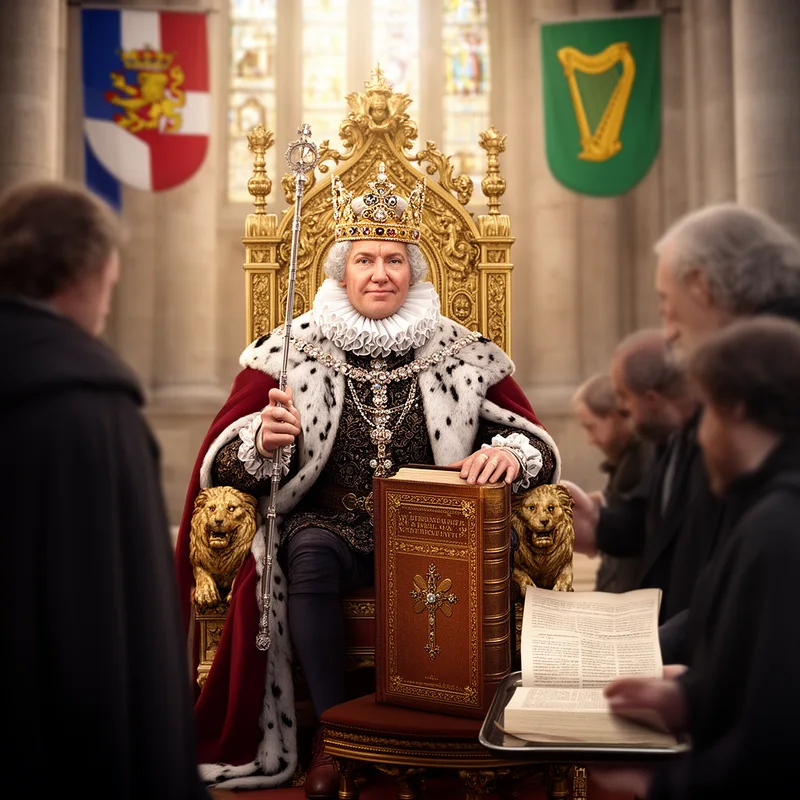
James I


 1
6.9
1
6.9
- proper noun
- The ascension of the Scottish King James VI to the throne of England (James I) commenced the strengthening of the religious ideology.
Examples
-
A monarch's divine ability to cure scrofula was an established ritual when James I came to the English throne in 1603.
Academic text (2011) -
James I was the first monarch to rule both James I England and Scotland after uniting the two crowns in 1603.
-
This was in the first quarter of the 17th century, when James I was king of England and Scotland.
Blog text (11) -
James VI of Scotland becomes James I of England, and a new era dawns in the battle for the English crown.
-
King James I granted a charter to the Virginia Company, London entrepreneurs, to establish a settlement in the Chesapeake region of North America.
Academic text (2006) -
In 1604, King James I authorized the translation of the Bible that would later be known as the King James Bible.
-
The reign of James I marked a significant period in British history, characterized by the union of the crowns and the Gunpowder Plot.
Synonyms
 156
5.3
156
5.3
The king who united England and Scotland and asked for the King James Bible
 8
6.6
8
6.6
The king who ruled England and Ireland from 1603 to 1625 and ordered the King James Bible
 1
7.0
1
7.0
A king who ruled England, Scotland, and Ireland in the early 1600s and ordered the King James Bible

A king who ruled Scotland, England, and Ireland and united their crowns in the early 1600s
Surface Forms
Morphology
James + I
The form combines the proper name 'James' with a regnal numeral 'I' meaning 'the first', so the referent (King James the first) is compositionally indicated. However, understanding that 'I' is a Roman numeral and that monarchs are numbered requires specific cultural/orthographic knowledge that a B1 learner who only knows the surface constituents may not have, so it is only partially transparent.
Etymology
James I was the king who became ruler of England and Scotland in 1603 and who ordered a new English translation of the Bible called the 'King James Version'. Because he gave his name to that famous Bible and believed kings ruled by God's will, his name is still used today when people talk about that book and his style of rule.