

Industrial Revolution
 23
2.8
23
2.8

- noun
- /ɪnˈdʌstrɪəl ˌrɛvəˈluːʃən/
- During the Industrial Revolution, factories began to replace small workshops in Britain.
- the Industrial Revolution in England
- the beginning of the Industrial Revolution
- the first industrial revolution
Loading YouTube…
Watch on YouTubeIt really goes back to the first industrial revolution when we started revering machines.
- It really goes back to the first industrial revolution when we started revering machines.
- We have the tools for a green industrial revolution.
- My friends, this is the second industrial revolution.
- Thanks to coal miners, we had the industrial revolution.
- The larger point that has been going on really since the industrial revolution is our fascination with machines.
- Survive the printing press, continue to function through the scientific revolution, the Enlightenment, the industrial revolution to this day.
- It is exactly here to displace those routine jobs that were created by industrial revolution.
- So tell me, what is synthetic biology and why do you think it's the next industrial revolution?
- And I think that was the biggest change in in the human race since the Industrial Revolution.
- Our life expectancies were substantially more than double what they were before the industrial Revolution.
- And they very much were aware that this was a break with, you know, the pre industrial revolution kind of farmer labor era.
- And then start from scratch with the Industrial Revolution and see what we can learn by looking carefully at phenomena.
- Our digital revolution echoes the Industrial Revolution to which Smiles was directly responding, and we're not the first to wonder what its potential might be.
- One is it almost all started post industrial revolution and much more recent than that.
Examples
-
We have seen decades of evolution in the transportation industry since the Industrial Revolution began (1820-1870).
Academic text (2012) -
I'd love to hear your thoughts on the Industrial Revolution.
-
So this was a time when the industrial revolution was just getting started in in England.
-
So what would get the United States into the Industrial Revolution, which had already started in in Britain at that time?
-
Home of the Industrial Revolution.
-
More likely, they were sent over as part of the Industrial Revolution.
Fiction book (2002) -
However, there is a substantial difference between the Industrial Revolution and what we are going through today.
Academic text (2008) -
What are some of the negative impacts of the Industrial Revolution that you can think of?
-
And those were the highlights of the 19th century Industrial Revolution.
-
As cities grew during the Industrial Revolution, large suburban cemeteries replaced smaller urban churchyards.
Synonyms
 11
5.7
11
5.7
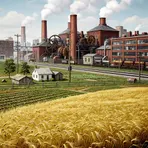
A change in a country from farming to making goods in factories
How Transformative
23
2.8

- Formal
2
5.0
1
6.8
310
3.9
Surface Forms
Morphology
The phrase is compositionally predictable: 'industrial' means relating to industry and 'revolution' means a rapid, major change, so a B1 learner knowing both words can infer it refers to a large-scale change in industry. This label is also lexicalized across many languages (e.g., Spanish 'Revolución Industrial'), so the basic meaning is transparent even if the specific historical details would require further knowledge.
Etymology
Industrial Revolution comes from the idea of a big 'revolution' in how people worked: Industrial means machines and factories, and Revolution means a sudden, large change. Imagine steam engines and long rows of machines replacing farm work done by hand; that's why the phrase means the time when industry changed life for millions.