
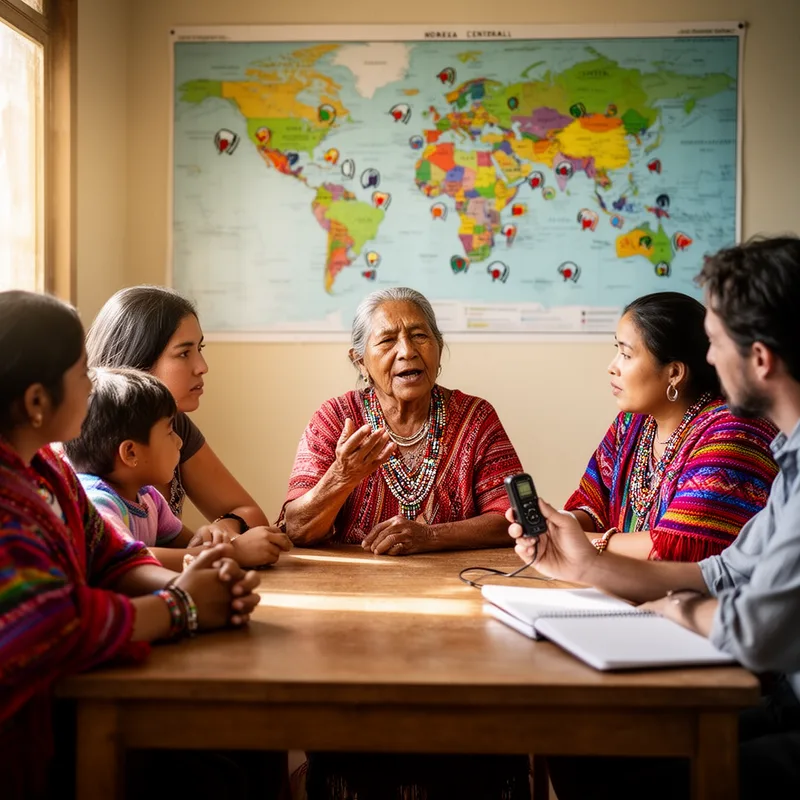
Indian language
- noun
- Archaic
- Many Indigenous children are taught to speak their ancestral Indian languages at home before they learn English in school.
Examples
-
In her research, she discovered that there are over 300 distinct Indian languages used by Indigenous communities across the continent.
-
This region is home to several distinct Indian languages that are still spoken today.
-
Many scholars have devoted their careers to documenting the grammar and vocabulary of Indian language families.
-
The treaty was signed after lengthy negotiations conducted in an Indian language.
-
Many Native Americans speak an Indian language.
-
The Indian languages are diverse and rich in culture.
-
The community is working hard to preserve their rich heritage, including various Indian languages that have been spoken for generations.
Synonyms

A language spoken by the native peoples of the Americas
A language of the native peoples of the Americas
A language spoken by the native people of the Americas

A language first spoken by the native people of the Americas before Europeans arrived
Surface Forms
Morphology
The meaning is directly compositional: 'Indian' (pertaining to Indigenous American peoples) combined with 'language' yields 'a language spoken by Indigenous peoples', following a common adjective+noun pattern that is cross-linguistically transparent. There is a possible ambiguity with 'Indian' meaning 'from India', but given the provided definition and typical contextual cues, a B1 learner who knows both words will readily derive the intended meaning.
Etymology
Indian language began as a name used by early European explorers who called the people they met 'Indian' because they thought they had reached India. So Indian language came to mean the languages of the native peoples of the Americas.

