

Hydrocharitaceae
- noun
- /ˌhaɪdrəˌkærɪˈteɪʃiː/
- Specialized
- The family Hydrocharitaceae includes many freshwater plants that thrive in lakes and ponds.
Examples
-
For example, once introduced into a lake, the long stems of plants like Elodea (Hydrocharitaceae) and Myriophyllum easily become entangled on boat motors and trailers and are eventually transported to different sites.
Academic text (1996) -
In the predominantly unisexual flowered family Hydrocharitaceae, several dioecious (male and female flowers on separate plants) species have become weedy even though only one sex had been introduced (Cook 1993, Hutchinson 1975, Sculthorpe 1967).
Academic text (1996) -
The range of pollination systems in the Hydrocharitaceae (Cook 1990) circumstantially supports this model.
Academic text (1996) -
Nevertheless, this appears to have been the case with the Hydrocharitaceae, which illustrates a convincing example for the evolution of hydrophily by means of the gradual model.
Academic text (1996) -
Hydrophily in most monocotyledons (excluding Hydrocharitaceae) and perhaps in the dicot Callitriche has conceivably evolved in such a fashion.
Academic text (1996) -
However, the condition ancestral to hydrophily is less certain in the family Hydrocharitaceae, in which only one genus (Limnobium) is strictly anemophilous (Cook 1988).
Academic text (1996) -
The system of floating flower reproduction in the Hydrocharitaceae could predictably lead to repeated contact of pollen with water and may select for adaptations to resist or accommodate wettability.
Academic text (1996) -
Because this unusual system is likely to represent the ancestral condition of most hydrophilous Hydrocharitaceae, it is inaccurate to state that hydrophily in this family has arisen directly from anemophily.
Academic text (1996) -
The evolution of hydrophilous systems in the marine Hydrocharitaceae and Najas, in which both pollen and stigmas are completely wet, would represent a subsequent stage of adaptation in such a gradual model.
Academic text (1996) -
Tanaka N, Uehara K, Murata J. 2004. Correlation between pollen morphology and pollination mechanisms in the Hydrocharitaceae. Journal of Plant Research 117:265-276.
Academic text (2012)
Synonyms

A group of simple water plants with little or no stem that live in fresh water
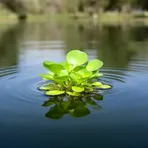
Small group of water plants with very short stems that float on ponds and lakes
Surface Forms
Morphology
Hydrocharitaceae = Hydrocharis (opaque) = Hydrocharit + aceae
The name is a Latinized botanical family formation using the specialized suffix '-aceae', which is unlikely to be transparent to a general English learner despite the 'hydro-' element suggesting 'water'.
Etymology
Hydrocharitaceae comes from Greek parts hydro- 'water' and charis 'grace', and the ending -aceae shows a plant family. So, the name means 'graceful water plants', which fits because this family is made of simple freshwater plants found in lakes and rivers.

