
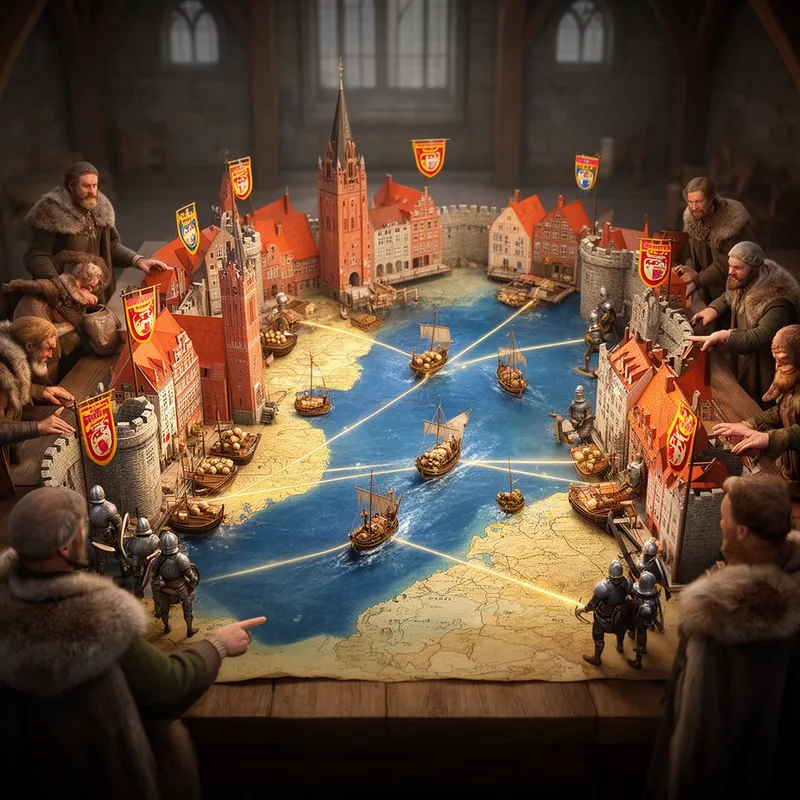
Hanseatic League
- proper noun
- The Hanseatic League played a crucial role in transforming trade in northern Europe during the 14th century.
- cities of the Hanseatic League
Examples
-
While much of the book reflects naval advances and activities, the rise of the fish trade in the latter centuries is also documented, along with the rise of the Hanseatic League and cities bordering the North Sea.
Academic text (1990) -
Among the friendly cities of the Hanseatic League, the confrontational policies of the Magdeburg city council failed to stir up concurrence.
Academic text (2005) -
Cities like Lübeck and Hamburg were vital members of the Hanseatic League, boosting their economies through commerce.
-
The decline of the Hanseatic League in the 16th century marked a significant change in the political landscape of northern Germany.
Synonyms

A medieval group of towns and merchants from northern Europe that traded together
Surface Forms
Morphology
This is a historical proper name: while 'league' (an alliance) gives a partial clue, the adjective 'Hanseatic' is a language-specific, etymological label rather than a compositional, semantically transparent word, so a B1 learner who only knows the constituents would not reliably infer the medieval commercial confederation sense. The meaning is therefore not derivable from the parts and functions like an idiomatic or encyclopedic label, making it opaque to typical learners.
Etymology
Hanseatic League comes from the old word Hanse, meaning a group of traders who travelled together for safety, and League, meaning a group or agreement of towns. So the name explains the idea: many northern 'cities' joined to trade and protect their ships and goods in the Middle Ages, which is why we call that trading network the Hanseatic League.

