
Hanseatic


 1
9.4
1
9.4
- adjective
- /ˌhænziˈætɪk/
 :
hanseático
:
hanseático
- The Merchant City Bremen, former Hanseatic town and throughout its history a separate state in the German political mosaic, became the foremost continental emigration port during the decades before 1914.
- Hanseatic League
- Hanseatic city
- Hanseatic town
Examples
-
Among the friendly cities of the Hanseatic League, the confrontational policies of the Magdeburg city council failed to stir up concurrence.
Academic text (2005) -
While much of the book reflects naval advances and activities, the rise of the fish trade in the latter centuries is also documented, along with the rise of the Hanseatic League and cities bordering the North Sea.
Academic text (1990) -
In some Hanseatic cities, there were both Sephardic and Ashkenazi communities.
Blog text (7) -
The Hanseatic captain, Paul Benecke, sailed the galley and all of its cargo back to Gdansk, where the painting has remained until the present day.
Academic text (1991) -
The political elite of the Hanseatic town used the vacancy of the Magdeburg archbishopric, its lawful political authority, to achieve the goal of full political autonomy, which the town had pursued since the thirteenth century with increasing success.
Academic text (2005) -
Increasing sea ice and the reorientation of Scandinavian trade toward the Hanseatic-controlled Baltic market reduced the colonies' contact with Europe in the thirteenth and fourteenth centuries.
Academic text (1998) -
The defeat also destroyed the leading military and political territory of the Protestants, Ernestine Saxony, deprived it of its electoral dignity, and caused the proud Hanseatic town of Magdeburg to resist the emperor's demand for surrender.
Academic text (2005) -
Even Bremen, which, like Magdeburg, had refused submission to the emperor at the end of the War of Schmalkald and whose three-month siege had ended in May 1547 despite support from soldiers from Magdeburg and Hamburg, now submitted to the emperor, as did the other cities of the Hanseatic League.
Academic text (2005) -
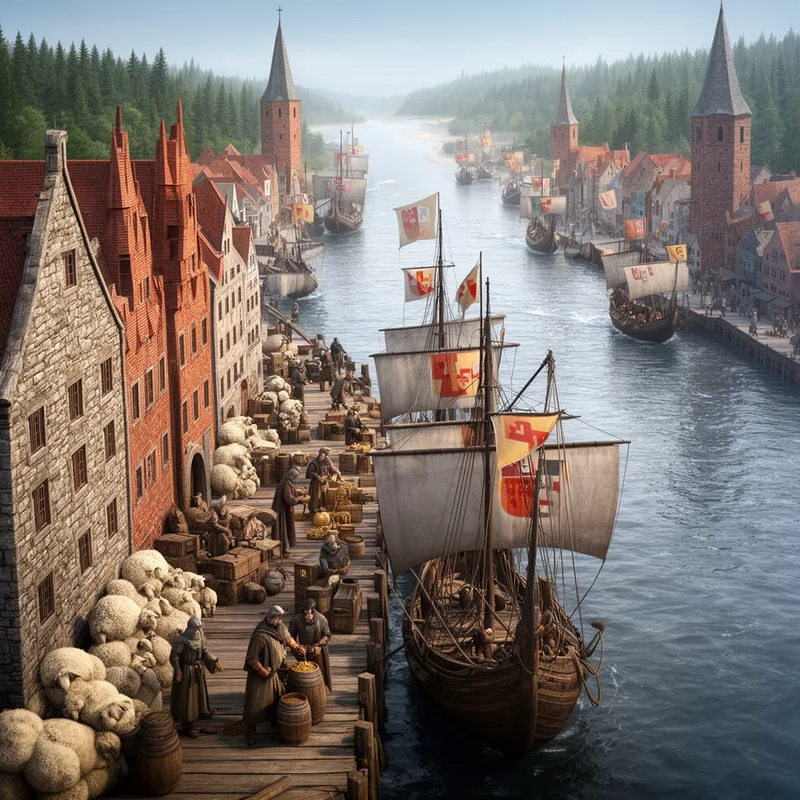
The merchant ship sailed into the Hanseatic port, bustling with trade and activity.
-
During the medieval period, the Hanseatic cities thrived on commerce across the North and Baltic seas.
Compounds

A group of northern European trading cities that worked together for trade and protection in the Middle Ages
Surface Forms
Morphology
Hanseatic = Hanse (transparent) = Hanse + atic
Formed by adding the adjectival suffix '-atic' to 'Hanse', a regular derivation meaning 'relating to the Hanse', though the base is a specialized historical term learners may not know.
Etymology
Hanseatic comes from the old German word hansa, which meant 'band' or 'group' and gave its name to the Hanseatic League, a group of trading cities in northern Europe. So Hanseatic describes things that belong to or come from that trading group.