
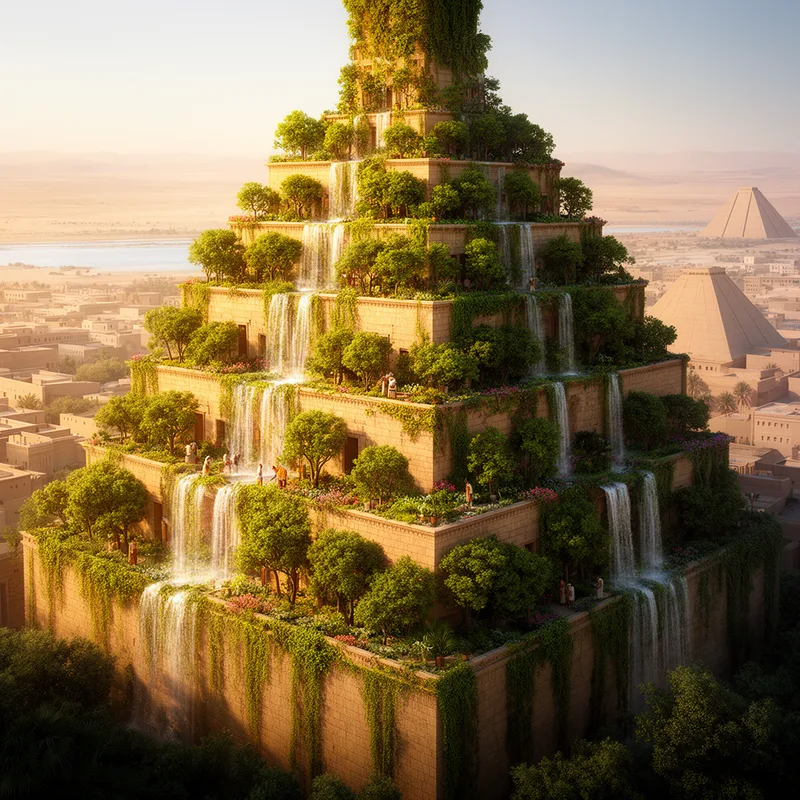
Hanging Gardens of Babylon


 1
8.2
1
8.2
- proper noun
- Literature
- Tourists often dream of visiting the Hanging Gardens of Babylon, one of the Seven Wonders that showcases the ingenuity of ancient engineering.
Examples
-
The Hanging Gardens of Babylon were considered one of the Seven Wonders.
-
The ancient civilizational marvel known as the Hanging Gardens of Babylon is said to have displayed stunning terraces of various plants.
-
Ancient texts describe the Hanging Gardens of Babylon as a marvel of engineering and design.
-
Many historians question whether the Hanging Gardens of Babylon ever actually existed.
-
Tourists are fascinated by stories of the Hanging Gardens of Babylon and their legendary beauty.
-
Many historians debate the existence of the Hanging Gardens of Babylon.
-
According to historical accounts, the Hanging Gardens of Babylon were built by King Nebuchadnezzar II for his wife, who missed the green hills of her homeland.
Surface Forms
Morphology
hanging + garden + of + Babylon
The meaning is directly compositional: 'hanging' (suspended/terraced) + 'gardens' + 'of Babylon' indicates gardens associated with Babylon, so the idea of ancient terraced gardens is inferable from the parts. This follows a common noun + of + place pattern cross-linguistically, so a B1 learner who knows the constituent words would understand the basic referent.
Etymology
Hanging Gardens of Babylon may come from old stories about a king who built high stone terraces and planted trees and vines that fell over the edges, so the green plants looked like they were hanging and formed beautiful gardens above the city. That's why the name makes us picture a famous, possibly legendary, green place that seemed to 'hang' over Babylon.