
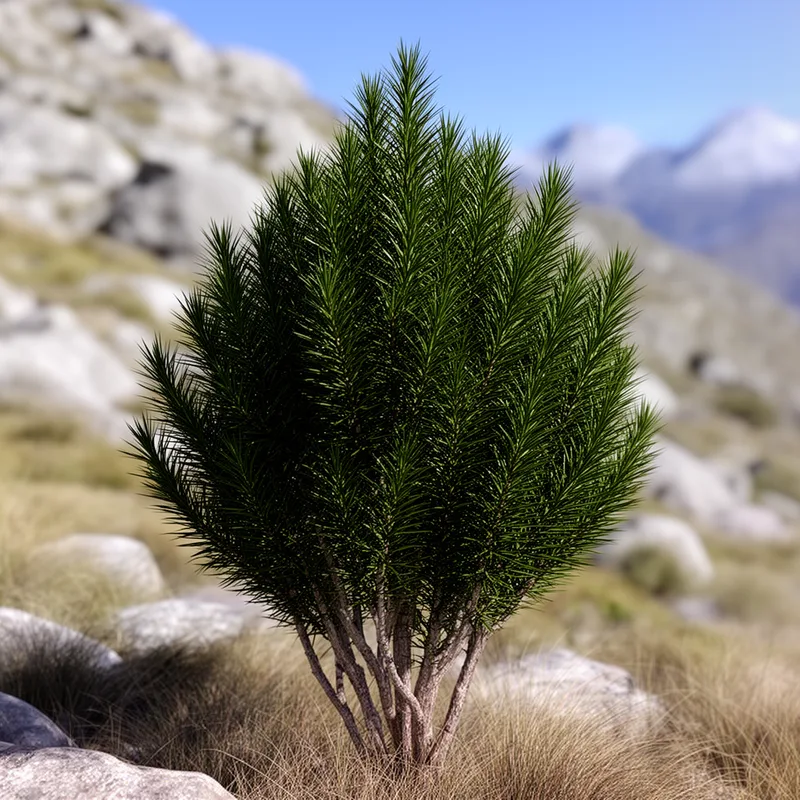
Halocarpus bidwilli
- proper noun
- Specialized
- The Halocarpus bidwilli is found in alpine and subalpine regions of New Zealand.
Examples
-
Did you know that Halocarpus bidwilli can grow up to 10 meters tall?
-
The foliage of Halocarpus bidwilli is valued for its unusual texture and appearance.
-
Botanists studied the distribution of Halocarpus bidwilli in native forests.
-
The Halocarpus bidwilli is a unique tree found in New Zealand.
-
The Halocarpus bidwilli thrives in the cool, moist climates of New Zealand's mountainous regions.
-
In New Zealand, Halocarpus bidwilli is known for its distinctive needle-like leaves and resilience.
-
You can often spot Halocarpus bidwilli among the alpine flora during a hike in the South Island.
Surface Forms
Morphology
Halocarpus + bidwilli
This is a Latin binomial (scientific) name whose overall meaning — a specific species of tree — is taxonomic rather than compositional; the label does not combine ordinary English word senses to yield the definition. The second element 'bidwilli' is not a lexical word with independent meaning in English, and even knowing 'Halocarpus' as a genus name would not let a B1 learner infer the species-specific sense. Because the name functions as a proper scientific label rather than a predictable phrase, it is not transparently interpretable from its parts.
Etymology
Halocarpus bidwilli is a scientific name made of two parts: the group name Halocarpus and the species name bidwilli. The second part bidwilli is a Latin form of a person's name and likely honors the botanist Bidwill who first collected or described the plant, so the name tells us this tree belongs to the Halocarpus group and is 'of Bidwill'.

