
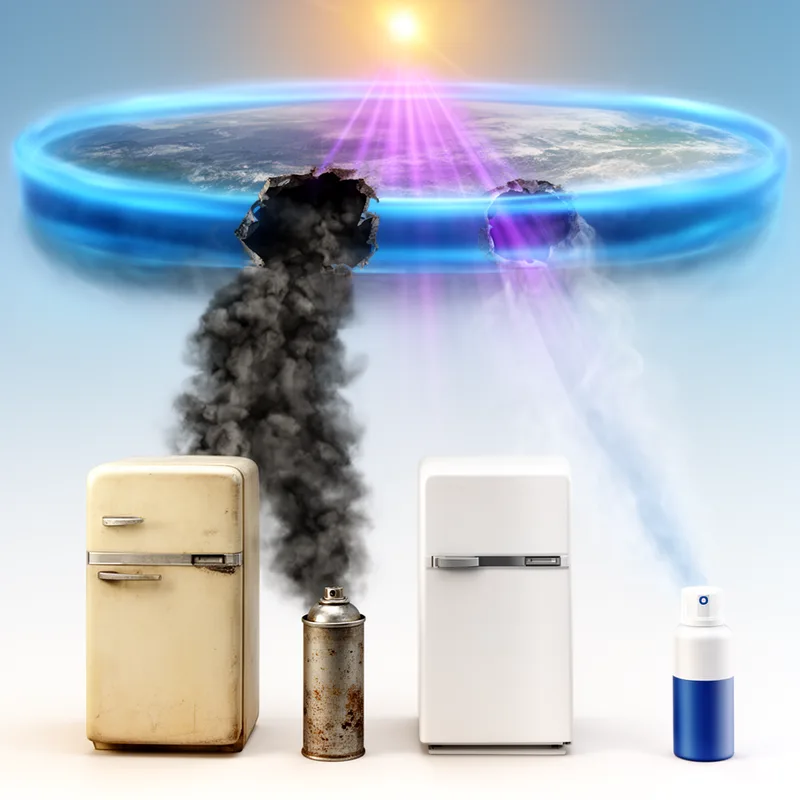
HCFC
- noun
- /ˌeɪtʃ si ɛf si/
- Specialized
- Regulations are being put in place to gradually phase out the use of HCFCs around the world.
- hydrochlorofluorocarbons (HCFCs)
- HCFCs and CFCs
- replacing HCFCs
Examples
-
The current HCFC candidates to replace CFC-11 in commercial chillers are HCFC-123 and HCFC-134a.
Academic text (1993) -
Hydrochlorofluorocarbons (HCFCs) are second-generation chemical relatives of CFCs.
Academic text (1991) -
Starting in 1996, the use of HCFCs has been scheduled to end as well.
Academic text (2007) -
"Developing countries have no current HCFC reduction schedule, except for termination on January 1, 2040," he said.
Academic text (2007) -
Recent studies indicate that HCFCs may remain in the stratosphere approximately fifty percent longer than originally predicted.
Academic text (1991) -
The HCFCs contain chlorine and therefore are still ozone-depleting substances.
Academic text (1998) -
There are medical, national security, and aviation safety exceptions to the CFC and HCFC bans, but these exceptions are very specific, and each has a threshold limit.
Academic text (1991) -
Among several groups of alternatives, two—the hydrochlorofluorocarbons (HCFCs) and the hydrofluorocarbons (HFCs)—are the most useful.
Academic text (1998) -
Many air conditioning units use HCFCs because they are less damaging to the ozone layer than CFCs.
-
Several companies are transitioning away from HCFCs to more environmentally friendly refrigerants.
Synonyms
A gas used in fridges and spray cans that harms the ozone layer less than older chemicals
How Ozone-Damaging


Surface Forms
Morphology
HCFC = H + C + F + C
HCFC is an initialism formed from the initials of a technical compound name and is not analyzable into productive English morphemes that would allow a learner to infer its meaning.
Etymology
HCFC is a chemical abbreviation made from hydro- meaning 'hydrogen', chloro- meaning 'chlorine', fluoro- meaning 'fluorine' and -carbon meaning 'carbon'. So an HCFC is a refrigerant named for the atoms it contains and is like CFC but with hydrogen added, which helps make it less harmful to the ozone layer.