

Gyromitra esculenta
- noun
- Specialized
- The wrinkled, brain-like appearance of Gyromitra esculenta distinguishes it from true morels.
Examples
-
The Gyromitra esculenta, also known as the false morel, can cause severe illness if eaten.
-
Many mushroom foragers mistake Gyromitra esculenta for edible morels, which can lead to poisoning.
-
Despite its species name meaning 'edible,' Gyromitra esculenta is highly toxic and should not be consumed.
-
The Gyromitra esculenta is often mistaken for edible mushrooms.
-
Be careful not to consume Gyromitra esculenta!
-
Identifying Gyromitra esculenta in the wild is crucial, as it resembles safe mushrooms but is dangerously poisonous.
-
Caution is advised when foraging, as Gyromitra esculenta may look appealing but is not safe to eat.
Synonyms
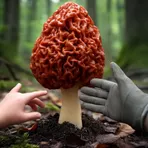
A poisonous mushroom with a wrinkled cap that looks like a brain

A poisonous mushroom with a wrinkled cap that can be deadly if eaten raw or not cooked properly
Surface Forms
Morphology
Gyromitra + esculenta
This is a Latin binomial (a scientific species name). Even if a learner knows 'Gyromitra' as a genus of false morels, species epithets like 'esculenta' function as arbitrary labels (and here is undefined), so the specific information that this is a particular poisonous species with a wrinkled cap cannot be derived from the parts. Therefore a B1 learner who only knows the constituents would not be able to infer the full meaning.
Etymology
Gyromitra esculenta may get its name from old Greek and Latin words that describe its look: Gyromitra suggests a twisted, turban-like cap (the mushroom's wrinkled, brain-like top) and esculenta means 'edible'. So the name gives a strong picture of the mushroom but can mislead you, because this fungus is actually poisonous.

