
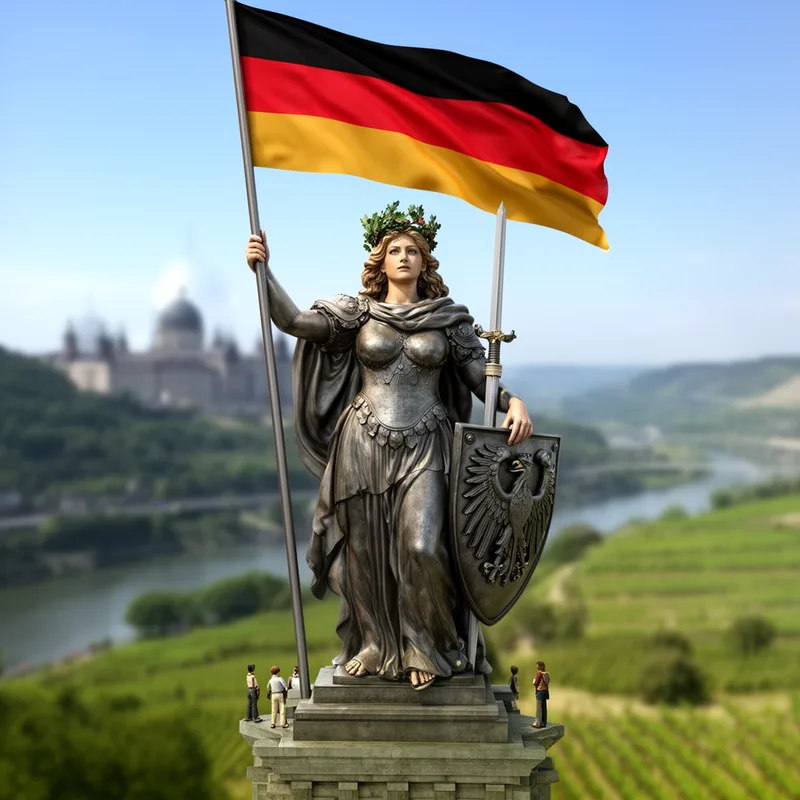
Germania
- proper noun
- Literature
- In many paintings, Germania is depicted as a strong woman holding a sword and shield.
Examples
-
A traditional allegorical presentation, Germania is shown rising from a deep slumber on a luxurious bearskin.
Academic text (1991) -
Germania first appeared in 1898 in "The Tightrope Walker" as a young and zaftig figure walking a tightrope above the naval powers en route to the Boxer Rebellion (2 April 1898, 1) (Figure 2).
Academic text (2008) -
Germania solicits "a kiss under the mistletoe" from the British Tommy in a last effort to keep the peace (23 December 1912, 645).
Academic text (2008) -
On Germania's first appearance, she is walking a tightrope above the combined fleets of the great naval powers en route to the Boxer Rebellion (see Figure 2).
Academic text (2008) -
Polke, for example, refers to the Germania of the monument near Rudesheim from the last third of the nineteenth century, which was intended to commemorate the foundation of the German Reich in 1871.
Academic text (1999) -
The artist captured the essence of Germania as a symbol of national pride in his latest sculpture.
-
During the festival, Germania was celebrated as the personification of unity and strength in Germany.
Surface Forms
Morphology
Etymology
Germania for the female figure comes from the Latin name Germania, which means 'land of the Germans'. Artists turned that place-name into a woman who stands for the country, so Germania means Germany pictured as a single, proud person.

