
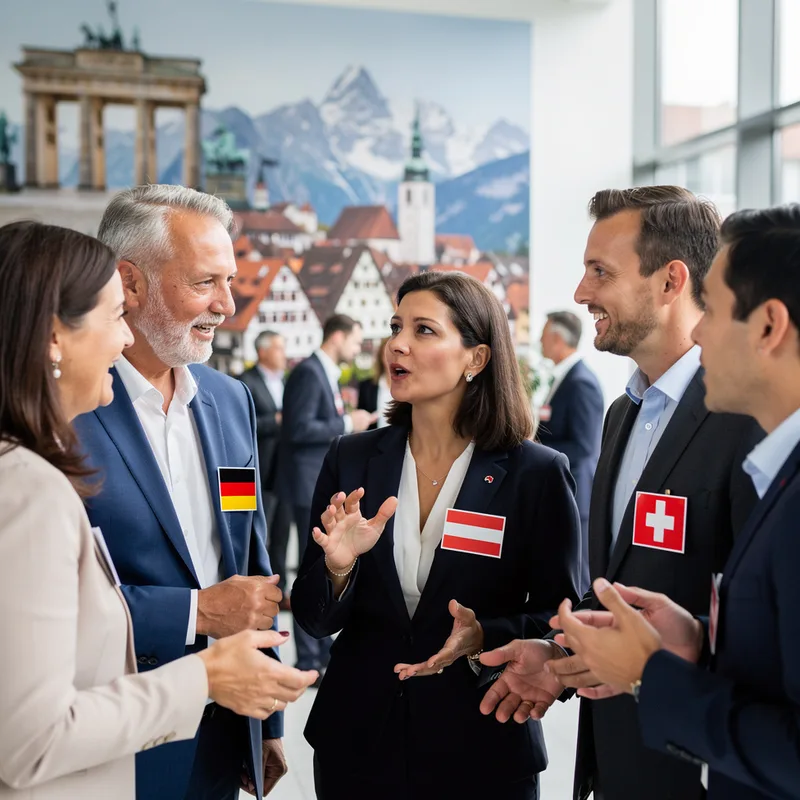
German-speaking
 4
3.4

- adjective
- Kashubes, a group of German-speaking Poles, soon dominated the parish.
- German-speaking Hungarians
- German-speaking elites in Transylvania
- German-speaking employer
Loading YouTube…
Watch on YouTubeThis country or this empire was not only a German speaking country.
- This country or this empire was not only a German speaking country.
Examples
-
During the nineteenth century, German-speaking elites in Transylvania developed a strong sense of German nationalism in response to state centralization.
Academic text (2016) -
The Pennsylvania Dutch were immigrants from German speaking areas of Europe.
-
Here we were received by two German-speaking GIs who presented themselves as our teachers.
Academic text (2008) -
The socialist labor journal he edited ran a German section that catered to German-speaking readers.
Academic text (2000) -
In Central Europe, migration began in the south, in Baden, Wuerttemberg, and the German-speaking areas of Switzerland.
Academic text (1993) -
The city's influential German-speaking employers had long taken advantage of ethnic bonds with workers to camouflage class differences.
Academic text (2000) -
Whether understood as German-speaking Hungarians or as Germans living in Hungary, members of this community articulated multiple national loyalties.
Academic text (2016) -
Many tourists visit Switzerland to explore its beautiful landscapes and converse with the German-speaking locals.
-
After moving to Berlin, he quickly learned that living in a German-speaking country would improve his language skills.
-
At the conference, we met scholars from various German-speaking regions sharing their research on cultural heritage.
How Fluent
6
2.8
 4
3.4
Surface Forms
Morphology
Etymology
German-speaking is made of two parts: German, meaning the language or the people of Germany, and speaking ('to talk'). So it means a person, family, place, or country where people 'speak German'.