

Geranium robertianum
- noun
- Specialized
- In early summer, clusters of Geranium robertianum brighten the forest floor with their purple flowers.
Examples
-
The wooded area was dotted with vibrant patches of Geranium robertianum in bloom.
-
Gardeners often remove Geranium robertianum to prevent it from spreading uncontrollably.
-
The Geranium robertianum blooms beautifully in spring.
-
Many gardeners enjoy planting Geranium robertianum in their yards.
-
In early summer, clusters of Geranium robertianum brighten the forest floor with their purple flowers.
-
The wooded area was dotted with vibrant patches of Geranium robertianum in bloom.
-
Many gardeners enjoy planting Geranium robertianum in their yards.
Synonyms
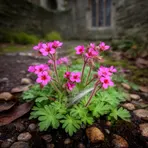
A low sticky plant with small pink flowers that grows across the northern half of the world
How Broad


Surface Forms
Morphology
Geranium + robertianum
The second element 'robertianum' is a Latin species epithet (not a regular English word and not in the learner's dictionary), so the binomial functions as an arbitrary taxonomic label rather than a compositional phrase. Although a learner who knows 'Geranium' might guess it is a kind of geranium, they could not derive the specific descriptive meaning from the constituents, making the expression opaque to a B1 learner.
Etymology
Geranium robertianum may come from two old ideas. The word geranium comes from a word for 'crane' because its seed pods look like a crane's beak, and robertianum comes from the folk name 'Herb Robert', probably after a man named Robert who used the plant, so the full name points to the plant's crane-like pods and the old folk name.