
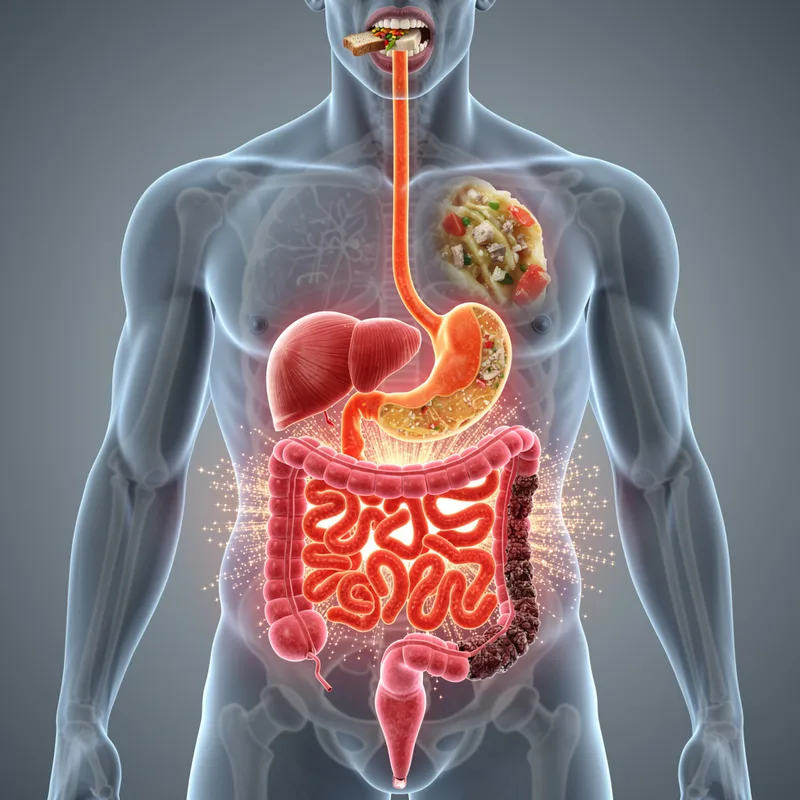
GI tract
 2
4.2
2
4.2

- noun
- /dʒiː aɪ trækts/
- Specialized
- Ryan is at risk of strictures developing along the GI tract, which can occur 1 to 7 weeks after ingestion.
- the gastrointestinal tract
Loading YouTube…
Watch on YouTubeSo far, my GI tract has not exploded like a frag grenade.
- So far, my GI tract has not exploded like a frag grenade.
- I think the question is why is it the heart and the brain doesn't have that much a stem cell compared to the skin, compared to the GI tract.
- And like the rest of his GI tract, because to do a colonoscopy to go from the top up, you'd have the bottom up.
- So, you know, it's, it's mucus not just in the GI tract, but also cervical mucus.
Examples
-
By this point, his metabolic acidosis had resolved and fluid losses from the GI tract were minimal.
Academic text (2007) -
Despite fluid boluses and blood transfusions, Ryan remained hypotensive and continued to have fluid losses from his GI tract.
Academic text (2007) -
But if you take a bolus of liquid sugar, it's going to make it further down the GI tract than the solid.
-
And so tonight we're going to be focusing on the GI tract and how it works and when it goes awry.
-
Absolutely, yes, the GI tract is very, very tied to circadian controls, right.
-
However, NSAIDs are associated with a range of adverse side effects, which primarily affect the GI tract.
Blog text (13) -
The iron-rich blood of the GI tract passes into the liver via the portal vein.
Academic text (2007) -
Ryan underwent abdominal radiography to look for the presence of iron tablets in his GI tract.
Academic text (2007) -
Irritable bowel syndrome (IBS) is a distressing and complex functional disorder of the gastrointestinal (GI) tract.
Academic text (2012) -
The bacteria in our GI tract number in the trillions.
Synonyms
 11
3.4
11
3.4
A long tube made of muscle from the mouth to the anus that breaks down food and removes waste
 3
3.9
3
3.9
A tube in the body from the mouth to the anus where food is digested and waste leaves the body

A tube in the body from the mouth to the anus that carries food and breaks it down

A long tube that runs from the mouth to the anus and carries food during digestion

A tube from the mouth to the anus where food is digested and waste leaves the body
Surface Forms
Morphology
The meaning is directly and compositionally derivable from 'GI' (gastrointestinal, pertaining to digestive organs) plus 'tract' (a bodily passage/system), so the phrase denotes the digestive passage. Though somewhat technical, this follows standard medical naming patterns and would be understandable to a B1 learner who knows both constituents.
Etymology
GI tract is a short form of the long word 'gastrointestinal'. Think of GI as short for the stomach and intestines and tract as a tube or path in the body, so it means the tube from the mouth to the exit where food is digested and leaves the body.