
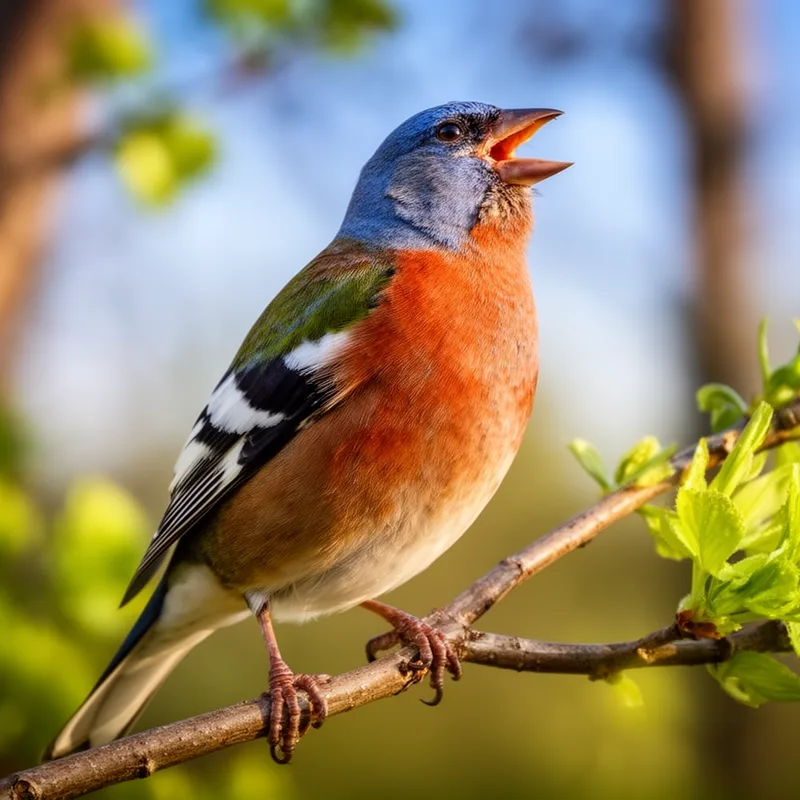
Fringilla coelebs
- noun
- Specialized
- The cheerful song of the Fringilla coelebs is a common sound in springtime Europe.
Examples
-
The Fringilla coelebs is widespread throughout European woodlands and gardens.
-
Birdwatchers often look for the Fringilla coelebs because of its distinctive plumage and lively song.
-
The Fringilla coelebs is often seen in gardens.
-
Did you hear the song of the Fringilla coelebs?
-
Birdwatchers often look for the Fringilla coelebs because of its distinctive plumage and cheerful song.
-
The Fringilla coelebs is widespread throughout European woodlands and gardens, making it a favorite among birdwatchers.
-
In spring, the cheerful song of the Fringilla coelebs fills the air, signaling the arrival of warmer weather.
Synonyms

 39
1.6
39
1.6

A small bird with a short thick beak that eats seeds


 1
9.7
1
9.7
A small European songbird with a blue-grey head and pinkish belly that sings cheerfully
 1
9.9
1
9.9
A small songbird like a chaffinch that sings cheerfully
Surface Forms
Morphology
Fringilla + coelebs
This is a Latin binomial (taxonomic) name: knowing 'Fringilla' (a genus of small birds) lets a learner infer it refers to a type of finch, but the species epithet 'coelebs' is not transparent or defined here and does not yield the common name 'chaffinch'. Because a learner could partially infer the general category (a bird/finch) but not the specific meaning, the expression is partially but not fully compositional for a B1 learner.
Etymology
Fringilla coelebs comes from Latin words: Fringilla was an old word for 'finch' and coelebs means 'single' or 'alone'. One popular idea is that people saw this small bird singing or sitting by itself, so that image became the name for this cheerful little songbird.