

Formica sanguinea
- noun
- Specialized
- Formica sanguinea colonies are known for capturing and enslaving workers from other ant species.
Examples
-
Researchers observed a group of Formica sanguinea conducting a raid on a nearby ant nest.
-
The bright coloration of Formica sanguinea makes it easy to identify in the field.
-
The Formica sanguinea is known for its aggressive behavior.
-
Have you ever seen a Formica sanguinea colony?
-
Formica sanguinea raided the neighboring ant colony to capture workers for its own colony.
-
In spring, the Formica sanguinea becomes especially active in seeking out other ant nests.
-
The behavior of Formica sanguinea is fascinating, as it often engages in slave-making activities.
Synonyms

An ant that raids other nests to steal young ants and make them work
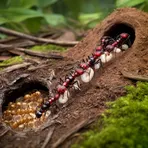
An ant that attacks other ant nests and takes their young to raise as workers in its own nest
Surface Forms
Morphology
Formica + sanguinea
This is a Latin binomial (a scientific species name) functioning as a proper noun; the given constituents do not encode the specific behavioral meaning ('slave-making ant') and the second element has no dictionary gloss here. Even if 'sanguinea' were understood as 'blood-red', that would at best suggest coloration, not the species' invasive/slave-making behaviour, so a learner cannot derive the MWE's meaning from the parts.
Etymology
Formica sanguinea gets its name from Latin: formica means 'ant' and sanguinea means 'blood-red', a picture of the ant's reddish color. These ants are famous for raiding other nests and taking their workers, so the name helps you remember this species and its behavior.

