

First of May
 1
3.8
1
3.8

- noun
- The first of May is a special holiday, marked by traditions and festivities in various cultures.
Examples
-
His court-martial was supposed to be on the first of May.
Fiction book (1994) -
We used to dance in the streets on holidays, New Years, first of May.
-
Furthermore, her first teaching assignment was right away, on the first of May.
Fiction book (1992) -
We were discussing my options because the first of May was nearing.
Blog text (29) -
You could even hear the battle cries of the class struggle on festive occasions, such as the First of May.
Fiction book (1993) -
Therefore, his unexpected and complete vanishment from all public ken shortly after the first of May, 1848, was remarked and lamented in the local press and church records.
Fiction book (1994) -
The comparison is justified when one looks at the custom of animating political cartoon characters and having live puppets play out their roles during communist celebrations, especially during the first of May parades.
Academic text (1990) -
Many countries celebrate Labour Day on the first of May with parades and events.
-
On the first of May, people often enjoy picnics and outdoor activities to welcome summer.
Synonyms
 8
3.3
8
3.3
A festival on May 1 that celebrates the start of summer and workers' rights
 7
1.0
7
1.0
The first day of May that many countries celebrate as a spring festival or a workers' holiday
Surface Forms
Morphology
The phrase is compositionally 'the first day of May', so a B1 learner who knows 'first' and 'May' will readily infer the date meaning. However, reading it specifically as the holiday 'May Day/Labour Day' requires cultural knowledge or prior exposure (though many languages mark May 1 as a public holiday), so the link to the holiday is not fully predictable from the words alone.
Etymology
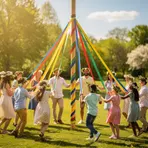
First of May comes from old spring celebrations where people danced around a decorated pole called a maypole to welcome 'summer'. Over time, workers also used the same date for marches and parades, so the First of May can mean the spring festival or 'Labour Day'.