
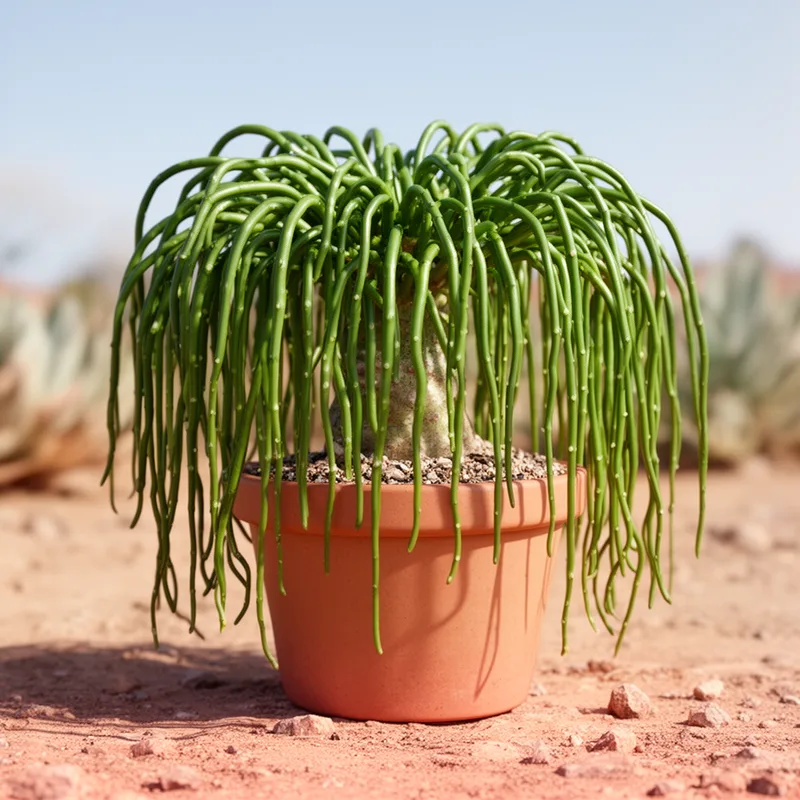
Euphorbia medusae
- noun
- Specialized
- The slender, drooping branches of Euphorbia medusae give it a unique, exotic look in any garden.
Examples
-
Botanists admire Euphorbia medusae for its numerous, snake-like branches.
-
The unique appearance of Euphorbia medusae makes it a popular choice among succulent collectors.
-
Euphorbia medusae thrives in well-drained soil and requires minimal watering.
-
The Euphorbia medusae thrives in arid conditions.
-
I bought a Euphorbia medusae for my garden.
-
Euphorbia medusae is commonly found in rocky deserts due to its ability to conserve water.
-
Many gardeners choose Euphorbia medusae for its striking shape and low maintenance requirements.
Synonyms

A small African plant with thick stems and many long, snake-like branches

A small African succulent plant with many thin hanging branches like snakes
Surface Forms
Morphology
Euphorbia + medusae
This is a scientific binomial (taxonomic) name: knowing 'Euphorbia' as a plant genus does not let a B1 learner infer the specific meaning 'a dwarf succulent shrub' because the epithet 'medusae' is not a common English word (not found in the provided dictionary) and is morphological/Latin rather than compositional. Species names function as labels rather than semantic combinations, so the overall meaning is not derivable from the constituents without prior botanical or lexical knowledge.
Etymology
Euphorbia medusae gets its name from the second word medusae, after Medusa, the Greek monster, because the plant's many thin, hanging branches look like her 'snake hair', so the name helps you remember its snake-like shape.

