
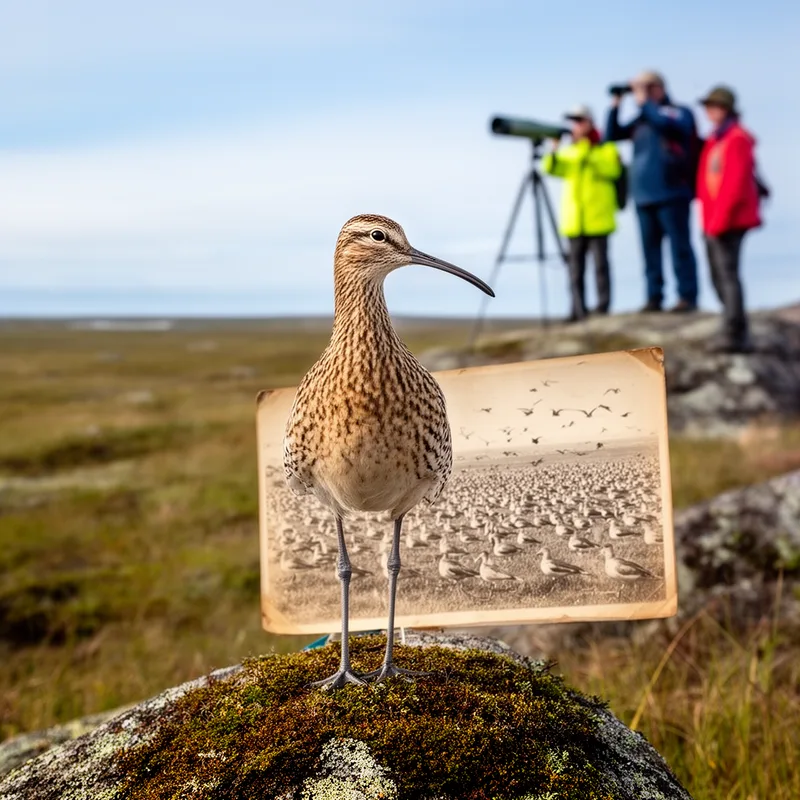
Eskimo curlew
- noun
- /ˈɛskɪmoʊ ˈkɜrlu/
- Specialized
- Photo: Once-abundant shorebirds, Eskimo curlews are now almost extinct.
Examples
-
The last recorded specimen of Eskimo curlew was shot on Barbados in 1963, but there have been a few sightings or photographic records in every decade of this century.
Academic text (1992) -
Eskimo curlews migrated to their wintering grounds by an eastern transoceanic route.
Academic text (1992) -
"Gourmet" feeding sites are as vital to these birds as they were to Eskimo curlews.
Academic text (1992) -
The Eskimo curlew is small in comparison to its North American relatives, the long-billed curlew and the whimbrel.
Academic text (1992) -
After refueling on the savannas, Eskimo curlews probably flew another thousand miles or two across Amazon forests to the llanolike belt of savanna to the south.
Academic text (1992) -
Photo: Once-abundant shorebirds, Eskimo curlews are now almost extinct.
-
The Eskimo curlew is small in comparison to its North American relatives, the long-billed curlew and the whimbrel.
-
Eskimo curlews migrated to their wintering grounds by an eastern transoceanic route.
Synonyms
A North American wading bird with a long curved bill, once common but now possibly extinct
Surface Forms
Morphology
The phrase is directly compositional: it denotes a type of curlew associated with the Eskimo/Arctic region, so a learner who knows 'Eskimo' (Arctic people/region) and 'curlew' (a migratory bird) can infer it is a bird from that area. This noun–noun naming pattern is common cross-linguistically and therefore readily understandable to B1 learners who know the constituents.
Etymology
Eskimo curlew comes from old reports of this long-billed shorebird, a curlew, seen in the far north near people then called Eskimo. So the name points to a northern shorebird that used to travel long distances and is now very rare or possibly extinct.

