

Ensete ventricosum
- noun
- /ɛnˈsɛteɪ vɛnˈtrɪkoʊsəm/
- Specialized
- Local farmers cultivate Ensete ventricosum for its edible shoots, which are an important food source in Ethiopia.
Examples
-
Although the fruit of Ensete ventricosum is not eaten, its stem and corm are widely used in traditional dishes.
-
The Ensete ventricosum is often referred to as false banana.
-
Researchers are studying Ensete ventricosum for its drought resistance and role in sustainable agriculture.
-
Farmers in Ethiopia cultivate Ensete ventricosum for its edible shoots.
-
Local farmers cultivate Ensete ventricosum for its edible flower shoots, which are a vital food source in Ethiopia.
-
The Ensete ventricosum, commonly known as false banana, thrives in the highlands of East Africa.
-
In Ethiopia, Ensete ventricosum is valued for its starchy corm and is often used in traditional cooking.
Synonyms

A large African plant like a banana whose fruit people do not eat but whose young shoots people eat

A large evergreen plant like a banana with very large leaves often grown in gardens
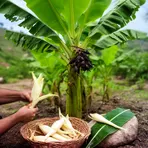
A large evergreen plant with big leaves whose fruit is not eaten but whose young flower shoots people eat
Surface Forms
Morphology
Ensete + ventricosum
This is a Latin binomial: the first element 'Ensete' signals the genus, so a learner who knows that word can infer it names a species of Ensete. However, the species epithet 'ventricosum' is not a familiar English word (no clear constituent meaning for a B1 learner) and the detailed descriptive sense (false banana, large tree-like herb) is not directly derivable, so the overall expression is only partially transparent.
Etymology
Ensete ventricosum is named for the plant's shape: it looks like a big banana plant with huge leaves and a thick, rounded stem. The scientific name may come from Latin meaning 'swollen belly', so you can remember it as a large, 'false banana' that is important as a food plant even though its fruit is not eaten.

