
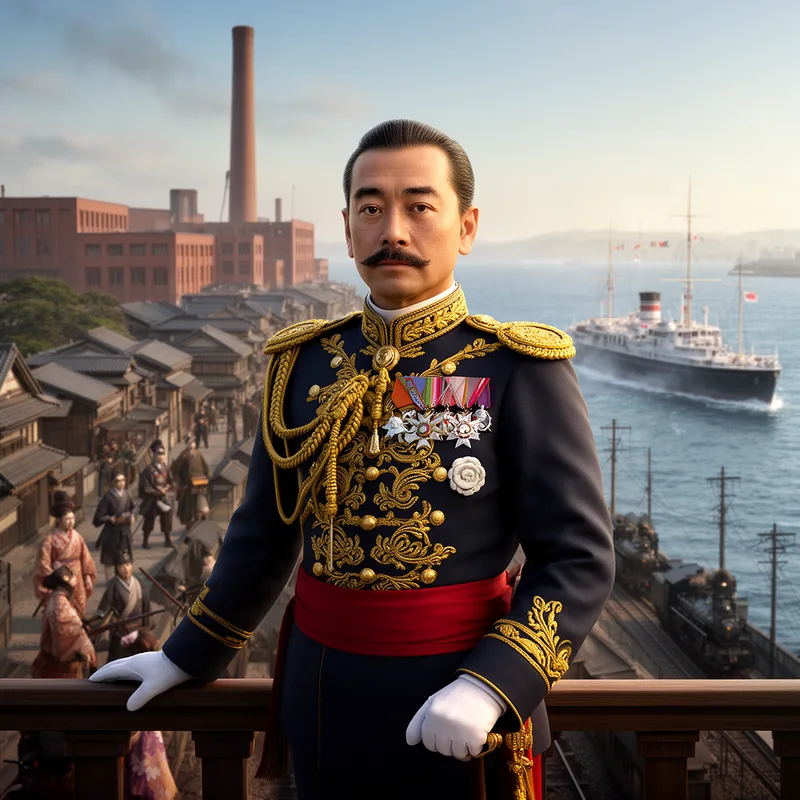
Emperor Meiji
 1
7.7

- proper noun
- /ˈɛmpərər ˈmeɪdʒi/
- Under the leadership of Emperor Meiji, Japan emerged as a major industrial power, changing the course of its history.
Examples
-
The Meiji Period lasted from 1868 to 1912, coinciding with the reign of Emperor Meiji. See McClain, supra note 20, at 116, 280.
Academic text (2016) -
The policies of modernization and westernization enacted by Emperor Meiji transformed Japan during his reign from 1867 to 1912.
-
The ambitious reforms implemented by Emperor Meiji propelled Japan into the modern era, significantly impacting its economy and society.
Synonyms
 1
8.7
The Japanese emperor who led Japan into modern times
The emperor of Japan from 1867 to 1912 who helped make the country more modern and open to the West
The emperor of Japan from 1867 to 1912 who helped make Japan modern
Surface Forms
Morphology
This is a straightforward title + proper-name combination: 'emperor' (a male sovereign) plus the proper noun 'Meiji' identifies the specific ruler. Given the provided definition of 'Meiji' (the sovereign who reigned 1867–1912 and modernized Japan), a B1 learner who knows both constituents can readily infer the referent. Such title+name constructions are morphologically and semantically transparent across languages.
Etymology
Emperor Meiji comes from the word Meiji, which means 'enlightened rule' or 'bright government'. People often call a Japanese emperor by the name of the time he ruled, and because he led Japan to become a modern country, the name helps us remember his role in those big changes.