

Einstein's theory of relativity
 3
6.8
3
6.8

- noun
- /ˈaɪnstaɪnz ˈθɪəri əv rɪˈlætɪvɪti/
- Specialized
- Einstein's theory of relativity revolutionized our understanding of space and time in modern physics.
- Einstein's theory of relativity predicts
- Einstein's theory of relativity says
- according to Einstein's theory of relativity
Examples
-
Einstein's theory of relativity states that time and space are not as constant as everyday life would suggest.
Blog text (5) -
Einstein's theory of relativity challenges the fundamental concepts of Newtonian physics and the implications reached by theology on the basis of Newton's insights.
Academic text (2009) -
Nonetheless, the implications of the theory of relativity for the existence of God have been widely discussed throughout the 20th century.
Academic text (2009) -
But, according to Einstein's theory of relativity, clocks in motion ticked more slowly than those at rest.
Academic text (1992) -
The theories of relativity affect all three main components in the Global Positioning System: the ground-based clock, the GPS satellite, and the radio signals.
Academic text (1996) -
The researchers also demonstrated that when the atomic clocks were altered in a way that mimics the effect of traveling through space, time began to slow down, as the theory of relativity says it should.
Blog text (5) -
Furthermore, the "slowing down of time" predicted by Einstein's theory of relativity would allow the spacefarers aboard them to return to their homes far younger than their former contemporaries!
Academic text (1992) -
According to Einstein's theory of relativity, gravity can affect the passage of time.
-
Many scientific advancements in physics are built upon the principles established in Einstein's theory of relativity.
Synonyms
 43
8.1
43
8.1
A theory in physics that space and time change depending on how you move
 12
6.7
12
6.7
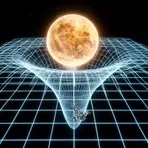
A scientific idea that space and time are linked and change with motion and gravity
 1
6.5
1
6.5
A scientific idea by Einstein that space and time depend on how fast something moves
Surface Forms
Morphology
Einstein's + theory + of + relativity
The phrase is fully compositional: 'Einstein's' indicates authorship/association, 'theory' denotes a set of scientific ideas, and 'relativity' names the specific concept. A B1 learner who knows these constituents can readily infer it refers to the scientific theory about relativity associated with Einstein; the possession + noun pattern is common cross-linguistically, so the meaning is predictable.
Etymology
Einstein's theory of relativity comes from Albert Einstein's idea that the way we measure 'space' and 'time' changes when we move fast. Imagine two clocks, one on a fast train that runs slower and one on the ground that runs faster; that's why the word relativity means 'not the same for everyone' and why the theory shows measurements depend on who is watching.