
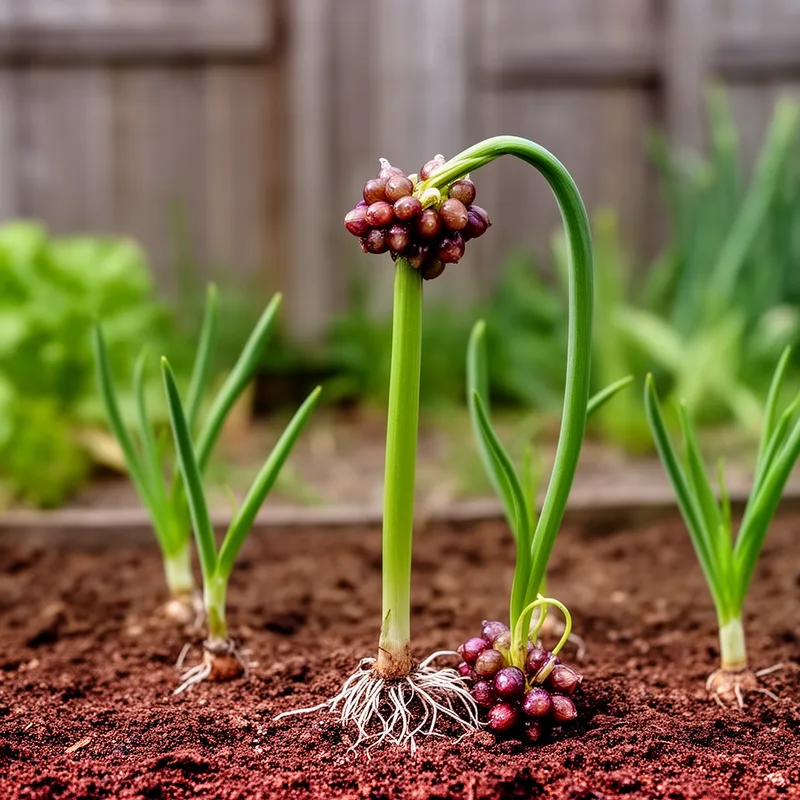
Egyptian onion
- noun
- /ɪˈdʒɪpʃən ˈʌnɪn/
- I planted an Egyptian onion in my garden.
Examples
-
You can use Egyptian onion greens in salads for an early, mild onion flavor.
-
The Egyptian onion is sometimes called the walking onion because it spreads by top-set bulbs.
-
My grandmother grows Egyptian onions in her backyard for their unique bulbils.
-
Have you ever tried Egyptian onions in a salad?
-
The Egyptian onion is unique because it can grow new bulbs on its stalks, allowing it to spread easily in the garden.
-
Many gardeners prefer Egyptian onions for their ability to produce edible greens and onions while requiring little care.
-
If you leave the Egyptian onion in the ground, it will develop bulblets that can be harvested for salad.
Synonyms
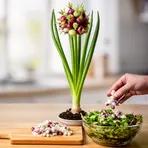
A plant that makes small bulbs on top of its stem used in salads
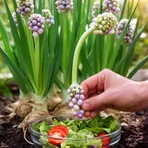
An onion that lives for many years and makes small bulbs on its stalks for salads

A plant that makes small bulbs at the top instead of flowers and gives young shoots for salads
Surface Forms
Morphology
The phrase is compositionally built from 'Egyptian' + 'onion' and will be interpreted by a B1 learner as a kind or variety of onion associated with Egypt (i.e., a specific type of onion). Adjective+noun nationality/type constructions are a regular, cross-linguistic pattern, so the meaning is predictable from the constituents.
Etymology
Egyptian onion is a kind of onion that grows little bulbs called bulbils at the top of its stem instead of flowers; these bulbs can fall or root and make new plants, so the clump seems to 'walk'. That's why people also call it 'walking onion' or 'tree onion', and why gardeners grow it for early salad greens and as an interesting, easy-to-grow onion.

