

Echinacea purpurea
- noun
- /ˌɛkɪˈneɪʃə pərˈpjʊəriə/
- Some studies suggest that Echinacea purpurea may support the immune system, but results are mixed.
Examples
-
Many people take Echinacea purpurea to help prevent colds during the winter months.
-
The health store sells Echinacea purpurea in both capsule and liquid forms.
-
Many people take Echinacea purpurea to boost their immune systems.
-
Is Echinacea purpurea effective against colds?
-
Many people take Echinacea purpurea capsules during winter to help prevent colds.
-
She prepared an herbal tea using Echinacea purpurea to boost her immune system.
-
Some studies suggest that Echinacea purpurea may reduce the duration of cold symptoms.
Synonyms
 7
8.2
7
8.2

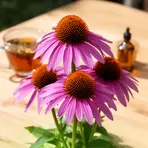
A tall garden herb with purple cone-shaped flowers often used to help the immune system

A group of rough, long-lived plants from North America with daisy-like flowers used in medicine
Surface Forms
Morphology
Echinacea + purpurea
This is a scientific binomial combining the genus name 'Echinacea' with the species epithet 'purpurea' (literally ‘purple’), so the phrase straightforwardly means the purple variety of the Echinacea plant — a medicinal coneflower. The composition follows standard biological naming conventions (genus + descriptive epithet), so a learner who knows both constituents can readily infer the MWE's meaning.
Etymology
Echinacea purpurea as a medicine is named after the plant because people make teas, drops, and capsules from the purple coneflower, so the name tells you the remedy comes from that flower.