
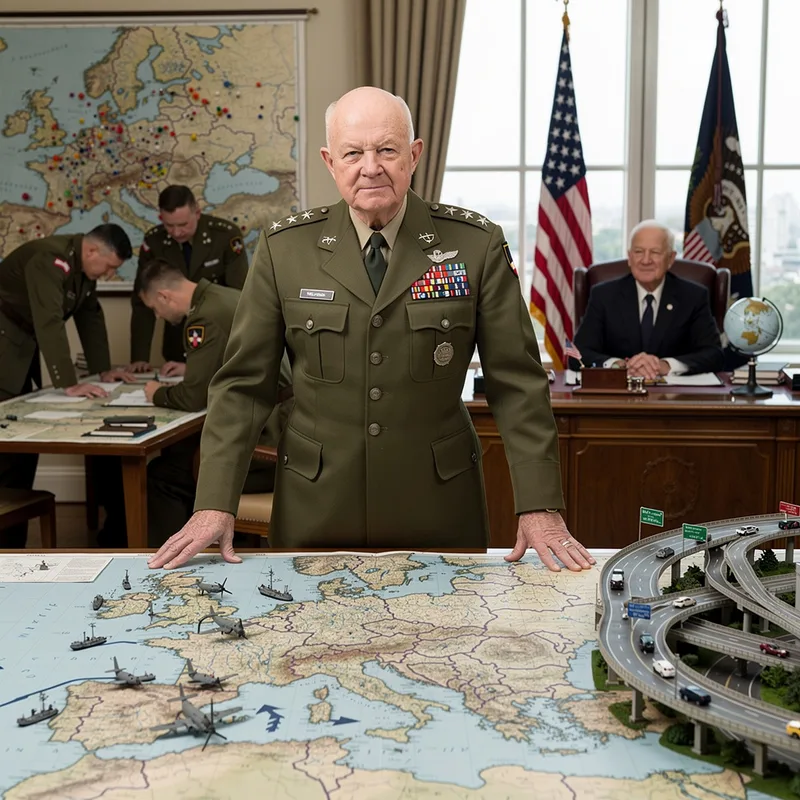
Dwight Eisenhower
 25
2.5

- proper noun
- /dwaɪt ˈaɪzənhaʊər/
- Thirty years ago, President Dwight Eisenhower, who believed deeply in the importance of good organization, observed that bad organization "can scarcely fail to result in inefficiency and can easily lead to disaster."
- President Dwight Eisenhower
Examples
-
When he left office in 1961, President Dwight Eisenhower came here immediately after John F. Kennedy's inauguration.
-
Blackmun became general counsel for the Mayo Clinic and Mayo Association, and in 1959 President Dwight Eisenhower appointed him to the 8th Circuit.
Academic text (1994) -
This is precisely the danger against which President Dwight Eisenhower warned in his farewell address.
Academic text (1992) -
After General Dwight Eisenhower became president in 1953, McCarthy continued his charges even against his own political party's administration.
Academic text (1990) -
But when President Dwight Eisenhower appointed Johnson in 1966 to the district court bench in Montgomery, Ala., the struggle had only begun.
Academic text (1994) -
Below, President Dwight Eisenhower's response to Soviet launches of Sputnik satellites in the fall of 1957 is examined in order to understand the relationship between public opinion and foreign policy in a particular context.
Academic text (1994) -
In 1956, President Dwight Eisenhower signed legislation that funded the interstate highway system.
-
Voiceover: The Queen's 1957 visit to the United States was hosted by President Dwight Eisenhower.
Synonyms
 129
4.2
A U.S. army general who became president and led the 1944 invasion of Normandy
 23
3.0
The 34th President of the United States from 1953 to 1961 who led Allied forces in World War II
 22
6.9
A nickname for Dwight D. Eisenhower, a United States general and president
 7
4.3
A US general who led Allied forces in World War II and became the 34th US President
 1
5.3
A general who became the 34th President of the United States and led the Allied invasion of Normandy
Surface Forms
Morphology
Dwight + Eisenhower
This item is a proper name referring to a specific historical individual; the referent (that he was the 34th U.S. President and Allied Supreme Commander) cannot be derived from the constituent words. Proper names are arbitrary labels rather than compositional phrases, so knowing the individual words does not yield the biographical meaning.
Etymology
Dwight Eisenhower was an American general who led the Allied armies in Europe during World War II and helped plan the D-Day invasion. He later became the '34th President of the United States' and promoted big projects like the interstate highways, so his name is a memory hook for strong leadership, careful planning, and national building.