
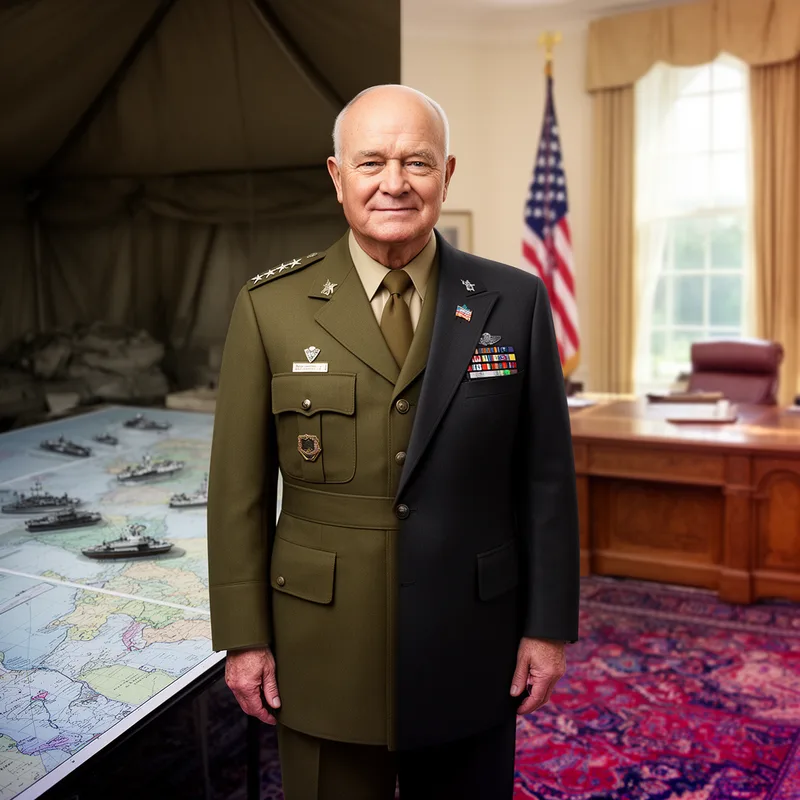
Dwight D. Eisenhower
 7
4.3

- proper noun
- /dwaɪt di ˈaɪzənhaʊər/
- The legacy of Dwight D. Eisenhower continues to influence American politics today.
Examples
-
Dwight D. Eisenhower warned of the influence of the "military-industrial complex" in his farewell address.
-
Many historians regard Dwight D. Eisenhower's presidency as a time of economic prosperity and growth.
-
Dwight D. Eisenhower served as the Supreme Commander of the Allied forces in Europe during World War II.
-
Did Dwight D. Eisenhower really lead the D-Day invasion?
-
Dwight D. Eisenhower served as the 34th President of the United States from 1953 to 1961.
-
As a five-star general, Dwight D. Eisenhower led the planning of the D-Day invasion during World War II.
-
Under Dwight D. Eisenhower's leadership, the U.S. experienced significant economic growth and prosperity.
Synonyms
 129
4.2
A U.S. army general who became president and led the 1944 invasion of Normandy
 25
2.5
An American general who led Allied forces in Europe and later became President of the United States
 23
3.0
The 34th President of the United States from 1953 to 1961 who led Allied forces in World War II
 22
6.9
A nickname for Dwight D. Eisenhower, a United States general and president
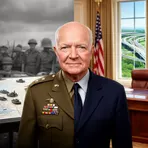 1
5.3
A general who became the 34th President of the United States and led the Allied invasion of Normandy
Surface Forms
Morphology
Dwight + D. + Eisenhower
This is a referential proper name whose meaning (the specific historical person and offices held) is world-knowledge rather than compositionally derivable from the parts. Knowing the constituents 'Dwight', 'D.' and 'Eisenhower' does not let a B1 learner infer that this person was the 34th U.S. President and five-star general, so the expression is opaque.
Etymology
Dwight D. Eisenhower was a five-star U.S. general and the 34th president who led the Allied landings at Normandy. His last name comes from the old German name Eisenhauer, meaning 'iron' and 'cutter', and the image of an 'iron cutter' helps you remember him as a strong military leader.