
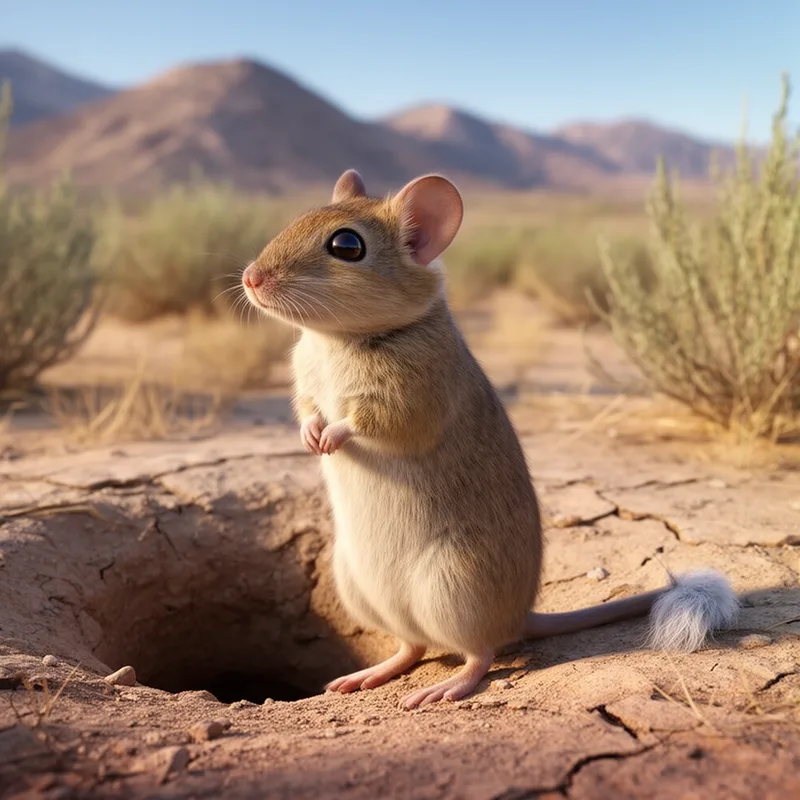
Dipodomys ordi
- noun
- Specialized
- The Dipodomys ordi thrives in arid plains and mountain regions of the American West.
Examples
-
Researchers studied Dipodomys ordi to understand its unique adaptations to dry environments.
-
Compared to other kangaroo rats, Dipodomys ordi occupies one of the broadest geographic ranges.
-
The Dipodomys ordi is known for its ability to survive in arid environments.
-
Have you ever seen a Dipodomys ordi in the wild?
-
The Dipodomys ordi, commonly known as the kangaroo rat, is often seen hopping across the sandy plains.
-
In the deserts of the western United States, the Dipodomys ordi is a vital part of the ecosystem.
-
Scientist observed that the Dipodomys ordi has adapted its diet to survive the harsh conditions of its habitat.
Synonyms
 1
6.3
1
6.3

A small desert animal like a mouse that hops on long hind legs and has a long tail

A small mouse-like animal with large back legs that hops and lives in burrows in the western United States
Surface Forms
Morphology
Dipodomys + ordi
This is a binomial scientific name following the transparent pattern Genus + specific epithet: knowing 'Dipodomys' as a genus of kangaroo rats allows a learner to infer the phrase denotes a species within that genus. The second element 'ordi' is an arbitrary species label without independent lexical meaning, but that does not prevent the compositional inference that this is a specific Dipodomys species.
Etymology
Dipodomys ordi starts with Dipodomys, a word that literally means 'two-footed mouse', and the second part ordi is likely a name given to honor a person who studied the animal. That image of a small 'two-footed mouse' is a clear memory hook because this kangaroo rat hops on its two strong back legs like a tiny kangaroo.