
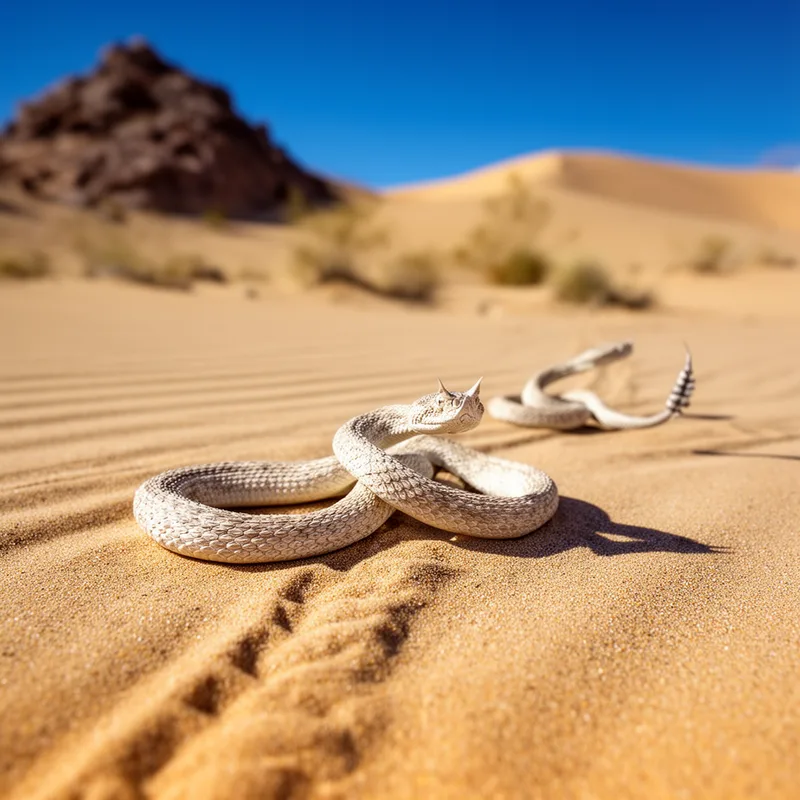
Crotalus cerastes
- proper noun
- Specialized
- You can identify a Crotalus cerastes by its pale color and the small horns above its eyes.
Examples
-
Scientists studied the movement of the Crotalus cerastes to understand its unique sidewinding locomotion.
-
The Crotalus cerastes is well adapted to the sandy deserts where it lives.
-
The Crotalus cerastes is often found in sandy desert environments.
-
Have you ever seen a Crotalus cerastes in the wild?
-
Researchers observed the Crotalus cerastes as it moved gracefully across the sandy terrain.
-
The Crotalus cerastes blends perfectly with its desert surroundings due to its pale coloration.
-
In the early morning, the Crotalus cerastes can be spotted sidewinding across the dunes.
Synonyms

 1
9.8
1
9.8

A small pale rattlesnake that moves sideways across desert sand
A small pale desert snake with a rattle and horn-like scales above its eyes in the southwestern United States
Surface Forms
Morphology
This is a taxonomic binomial: a learner who knows 'Crotalus' (a genus of rattlesnakes) can infer the phrase refers to a species of rattlesnake, so part of the meaning is compositional. However, the specific species traits (small, pale desert sidewinder motion) and the exact sense contributed by 'cerastes' are not directly predictable from the parts, making the overall meaning only partially transparent to a B1 learner.
Etymology
Crotalus cerastes comes from old Greek words: Crotalus means 'rattle' and cerastes means 'horned'. The name describes the small desert rattlesnake because it has a rattle and tiny horn-like scales above its eyes, so the name helps you remember the snake.