

Crocodylus niloticus
- noun
- South African
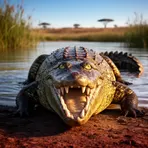
- Crocodylus niloticus is the largest predator in its habitat, often found lurking near rivers and lakes in Africa.
Examples
-
The National Geographic documentary focused on the hunting techniques of Crocodylus niloticus.
-
Scientists study the nesting habits of Crocodylus niloticus in the Nile River region.
-
Crocodylus niloticus is known for its size and aggressive nature throughout sub-Saharan Africa.
-
The Crocodylus niloticus is known for its aggressive behavior.
-
Have you ever seen a Crocodylus niloticus in the wild?
-
Many tourists are fascinated by the Crocodylus niloticus, especially during guided tours in national parks.
-
The fierce reputation of the Crocodylus niloticus makes it a subject of interest for wildlife documentaries.
Synonyms


 1
3.9
1
3.9
A large aggressive crocodile that lives in African rivers and lakes

A large, dangerous crocodile that lives in African rivers and lakes
Surface Forms
Morphology
Crocodylus + niloticus
This is a Latin taxonomic binomial rather than a regular English compositional phrase: knowing that 'Crocodylus' is a genus name and seeing an unfamiliar form 'niloticus' does not allow a B1 learner to infer 'Nile crocodile' without specialized biological or Latin knowledge. Scientific names function as technical labels/proper nouns and are not transparently built from everyday English vocabulary, so the meaning is not derivable by typical learners.
Etymology
Crocodylus niloticus is a scientific name that comes from old Greek and Latin words. Crocodylus is from a Greek word for 'crocodile' and niloticus means 'from the Nile', so the name shows a crocodile from the Nile and that is why it refers to the large Nile crocodile today.