

Crataegus crus-galli
- noun
- Specialized
- Gardeners must be cautious of the Crataegus crus-galli's long, sharp thorns when pruning.
Examples
-
The Crataegus crus-galli is often planted as an ornamental tree because of its attractive blossoms.
-
Crataegus crus-galli produces bright red fruit that birds enjoy in the autumn.
-
The Crataegus crus-galli is often used as a decorative plant.
-
Many gardeners appreciate the beauty of Crataegus crus-galli.
-
Crataegus crus-galli is commonly found in eastern North America, known for its thick branches and distinctive thorns.
-
When planting, consider that Crataegus crus-galli can grow quite tall and may require ample space.
-
Crataegus crus-galli is often favored for urban landscaping due to its resilience and vibrant flowers.
Synonyms
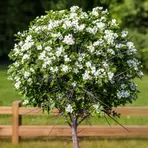
A small tree from eastern North America with long straight thorns and white flowers

A small tree or bush from eastern North America with long sharp thorns, white flowers, and red berries
Surface Forms
Morphology
Crataegus + crus-galli
This is a Latin binomial (taxonomic) name: 'Crataegus' signals the genus but does not by itself convey the common meaning 'cockspur hawthorn', and 'crus-galli' is a Latin compound not listed here and unknown to a B1 learner. The species name is specialist and not compositionally interpretable from everyday English vocabulary, so learners who only know the surface constituents would not be able to derive the referent without prior exposure or botanical/Latin knowledge.
Etymology
Crataegus crus-galli comes from Latin words crus 'leg' and galli 'of a rooster'. The tree has long, straight thorns that look like a rooster's spur, so people call it 'cockspur hawthorn' and the name reminds you of its sharp thorns.

